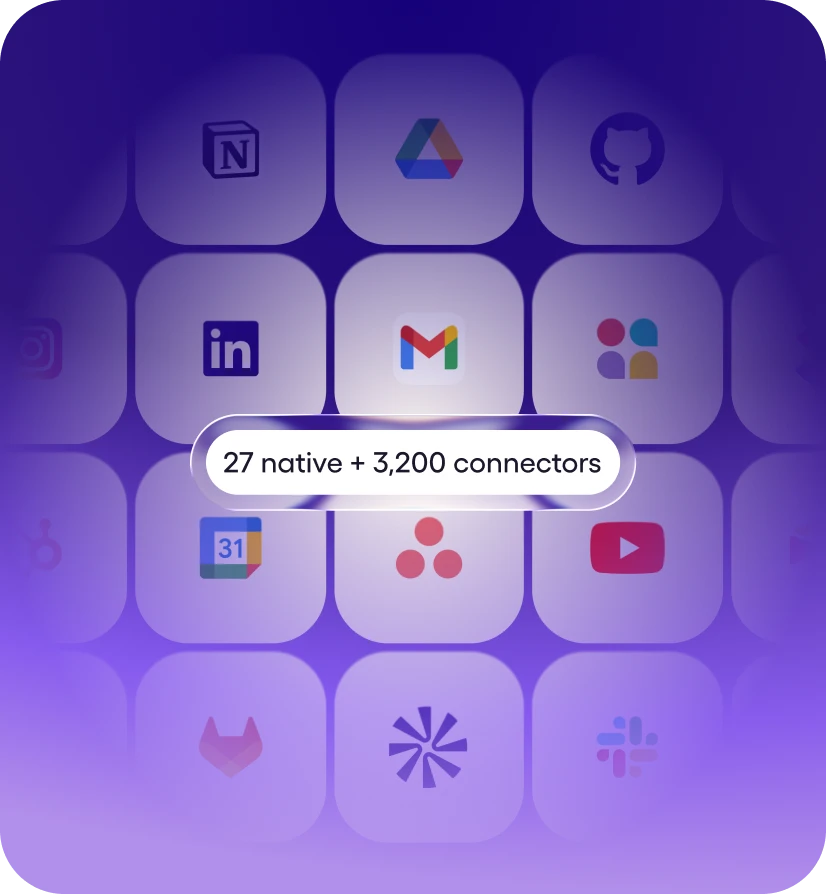
Connect your stack
27 native integrations. 3,200+ tools via managed connectors. Most are one-click OAuth, some use API keys - Viktor handles auth and starts working. No webhooks, no Zapier zaps.
Viktor is an AI employee that connects to Webflow natively and helps you manage website content and publish updates, running 73 Webflow actions for you like Sites get, Sites list, and Style tool. Ask in plain English in Slack or Microsoft Teams; Viktor does the work in Webflow and reports back. Setup takes about two minutes.
Free to start · No credit card · SOC 2 Type 1 · Works in Slack & Microsoft Teams
Messages you'd actually send. Paste one into Slack or Microsoft Teams, swap in your specifics, and Viktor takes it from there.
“Draft a new page in Webflow from this outline and send it to me for review.”
— you, in Slack or Teams
“Update the copy on our pricing page in Webflow after I approve the changes.”
— you, in Slack or Teams
“List the Webflow content that has not been touched in six months and suggest refreshes.”
— you, in Slack or Teams
“Watch Webflow for new form submissions and summarize them here every Friday.”
— you, in Slack or Teams
Ask in plain English in Slack or Microsoft Teams. Viktor picks the right Webflow actions, runs the work, and reports back. No workflows to build.
Designer Tool - WHTML builder to insert elements from HTML and CSS strings on the current active page. Accepts HTML markup and optional CSS rules, constructs WHTML, and inserts into a parent element.
Designer Tool - Variable tool to perform actions like create variable, get all variables, update variable, rename and delete variables, and manage style variable modes.
Get component properties including default values and configuration for a specific component.
Update content on a component in secondary locales by modifying text nodes and property overrides.
Update component properties for localization to customize behavior in different languages.
List all components in a site. Returns component metadata including IDs, names, and versions.
Get detailed information about a specific site including its settings, domains, and publishing status.
Get the content structure and data for a specific component including text, images, and nested components.
List all sites accessible to the authenticated user. Returns basic site information including site ID, name, and last published date.
Designer tool - Learn more about styles supported by Webflow Designer.Please do not use any other styles which is not supported by Webflow Designer.Please use the long-form alias of a CSS property when managing styles. For example, the property row-gap has a long-form alias of grid-row-gap, margin has long-form alias of margin-top, margin-right, margin-bottom, margin-left, etc.
List all registered scripts for a site. To apply a script to a site or page, first register it via the Register Script endpoints, then apply it using the relevant Site or Page endpoints.
Publish a site to specified domains. This will make the latest changes live on the specified domains.
Publish draft items in a CMS collection to make them live.
Get the content structure and data for a specific page including all elements and their properties.
Get all scripts applied to a site by the App. To apply a script to a site or page, first register it via the Register Script endpoints, then apply it using the relevant Site or Page endpoints.
Update existing items in a CMS collection as drafts.
Update content on a static page in secondary locales by modifying text nodes and property overrides.
Get metadata for a specific page including SEO settings, Open Graph data, and page status (draft/published).
List all CMS collections in a site. Returns collection metadata including IDs, names, and schemas.
Get detailed information about a specific CMS collection including its schema and field definitions.
Create and publish new items in a CMS collection directly to the live site.
List items in a CMS collection with optional filtering and sorting.
Update and publish existing items in a CMS collection directly to the live site.
Create new items in a CMS collection as drafts.
Designer Tool - Component builder to insert component instances on the current active page. Supports inserting into an element (as a child) or into a component instance's slot. Use insertinelement to add a component inside a container/div/section. Use insertinslot to add a component inside a specific slot of an existing component instance.
Designer Tool - Get image preview from url. this is helpful to get image preview from url. Only supports JPG, PNG, GIF, WEBP, WEBP and AVIF formats.
Designer Tool - Style tool to perform actions like create style, get all styles, update styles, remove styles.
Designer Tool - Element builder to create element on current active page.
Designer tool - Component tool to perform actions like create component instances, get all components and more.
Delete an item in a CMS collection. Items will only be deleted in the primary locale unless a cmsLocaleId is included in the request.
List all pages within a site. Returns page metadata including IDs, titles, and slugs.
Update page settings including SEO metadata, Open Graph data, slug, and publishing status.
Register an inline script for a site. Inline scripts are limited to 2000 characters.
Data tool - Components tool to perform actions like list components, get component content, update component content, get component properties, and update component properties.
Create a new CMS collection in a site with specified name and schema.
Create a new static field in a CMS collection (e.g., text, number, date, etc.).
Create a new option field in a CMS collection with predefined choices.
Create a new reference field in a CMS collection that links to items in another collection.
Update properties of an existing field in a CMS collection.
Designer Tool - Element tool to perform actions like get all elements, get selected element, select element on current active page. and more.
Designer Tool - Page tool to perform actions like create page, create page folder, get current page, switch page, open a component in the Designer canvas, list branches, get current branch ID, get parent page ID for a branched page, and get current Designer mode.
Read Webflow Analyze report data for a site, including traffic timeseries, ranked pages, ranked dimensions, ranked engagement events, and aggregate or bucketed time on page. Includes guide actions for building Analyze queries and resolving engagement event rows to page elements, component instances, and CMS context.
Data tool - CMS tool to manage collections, collection fields (static/option/reference), collection field groups, and collection items (list, create, update, publish, unpublish, delete).
Data tool - Scripts tool to manage custom code scripts. Register, apply, update, and remove scripts at the site or page level, and read or write freeform head/footer custom code blocks.
Data tool - Manage agent instructions (rules and skills) for a site. Actions: searchinstructions, readinstruction, createinstruction, updateinstruction, deleteinstruction, moveinstruction. Paths must follow 'rules/<name>.md', 'rules/<name>.mdc', or '<skill-name>/SKILL.md'.
Data tool - Manage a site's uploaded custom fonts: list and inspect them, register new fonts and replace their files (a two-step upload flow), update font metadata, and remove fonts individually or in batches.
Data tool - Webhook tool to perform actions like list webhooks, create webhooks, get webhook details, and delete webhooks for a Webflow site.
Data Tool - Variable tool to perform actions like create variable, get all variables, query variables, update variable, rename and delete variables, and reorder variable collections.
Inspect and modify elements on a Webflow page: query the element tree, move or remove elements, and edit text, styles, links, images, heading levels, attributes, and display names.
Data tool - Component tool to manage component definitions and instances: create, query, transform, insert, unlink.
Data tool - Sites tool to perform actions like list sites, get site details, and publish sites.
Data tool - Enterprise tool to perform actions like manage 301 redirects, manage robots.txt and more. This tool only works if User's workspace plan is Enterprise or higher, else tool will return an error.
Data tool - A comment in Webflow is user feedback attached to a specific element or page inside the Designer, stored as a top-level thread with optional replies. Each comment includes author info, timestamps, content, resolved state, and design-context metadata like page location and breakpoint. Use this tool to inspect feedback discussions, filter threads by page, resolution status, or creation date, search for comment users by email, and create replies to existing threads.
Ask Webflow AI about anything related to Webflow API.
Provides essential guidelines and best practices for effectively using the Webflow tools. Call this tool to understand recommended workflows and important considerations before performing actions. ALWAYS CALL THIS TOOL FIRST BEFORE CALLING ANY OTHER TOOLS. ALWAYS CALL THIS TOOL FIRST BEFORE CALLING ANY OTHER TOOLS.
Data Tool - Style tool to perform actions like get all styles, create a new style, update a style, query styles, remove a style, and manage style variable modes.
Data Tool - Component builder to insert component instances on a page via the public-mcp headless surface. Supports inserting into an element (insertinelement) or into a component instance's slot (insertinslot), with recursive nested-component trees via componentschema.slots.
Data tool - Manage Webflow site assets and asset folders via the Data API. Creates asset metadata entries and returns presigned S3 upload information (uploadUrl and uploadDetails) used to upload the file bytes, and supports listing, updating, organizing, and deleting assets and asset folders, plus compressing image assets to webp or avif via async tasks.
Check for additional tools whenever your task might benefit from specialized capabilities - even if existing tools could work as a fallback.
Data Tool - WHTML builder to insert elements from HTML and CSS strings on a page via the public-mcp headless surface. Accepts HTML markup and optional raw CSS rules, constructs WHTML, and inserts it into a parent element.
Data tool - Manage sitemap indexing status for CMS collection items and static pages. Read and update whether pages and collection items appear in a site's generated sitemap. All endpoints are under the /beta namespace. Folder pages, collection template pages, and utility pages are not supported for page endpoints.
Data tool - Read forms and manage form submissions on a site. Actions: listforms, getform, listsiteformsubmissions, listformsubmissions, getformsubmission, updateformsubmission, deleteformsubmission.
Data Tool - Element builder to create elements on a page via the public-mcp headless surface.
Interact with the user's live Webflow Designer session — select an element on the canvas or read which element is currently selected, navigate the canvas between pages and component canvases, switch to or read the current page, list a page's branches, read the current branch ID, parent page ID, and Designer mode, enter, exit, or inspect the current component view, and read all breakpoints (media queries) configured for the site.
Data tool - Pages tool to perform actions like list pages, get page metadata, update page settings, create a page, bulk update page settings, manage branches and their staging previews, and read or write JSON-LD schema markup for pages in bulk.
Data tool for localizing pages and components into secondary locales. Read and update static page content, component content, and component property overrides for any non-primary locale. Writes target secondary locales only — the primary (default) locale cannot be edited through this tool. Also includes listcomponents for discovering component IDs to localize.
Designer Tool - Upload an image from a publicly accessible URL as a Webflow asset. Other asset and folder management is handled by dataassetstool.
Designer Tool - Element snapshot tool to perform actions like get element snapshot. helpful to get element snapshot for debugging and more and visual feedback.
Get an image preview of a site asset by its asset ID. Fetches the asset's metadata, downloads the smallest available image variant (or the original file when no variants exist), and returns the image content. Works with any image content type (e.g. JPG, PNG, GIF, WEBP); non-image files and files larger than 2 MB return an error instead of an image. Returns a 404 error if the asset does not exist or has been deleted.
Data tool - Component props tool to manage prop definitions and set or reset prop values on component instances.
Read and write element settings and data bindings on a Webflow page: get or set settings, discover bindable sources, and set tag, visibility, and DOM id via static values or prop bindings.
Data tool - Component variants tool to manage variants and per-variant style overrides.

27 native integrations. 3,200+ tools via managed connectors. Most are one-click OAuth, some use API keys - Viktor handles auth and starts working. No webhooks, no Zapier zaps.

Message Viktor in Slack like you'd message a teammate. "Draft a new page in Webflow from this outline and send it to me for review." "Update the copy on our pricing page in Webflow after I approve the changes." Plain English, any tool.
Viktor opens Webflow, runs the work, and posts back what changed. Sensitive actions wait for your approval. Everything is logged. You stop doing the work and start reviewing it.
A Webflow AI agent is an AI that connects to your Webflow account and completes work in it - it doesn't just answer questions about Webflow, it takes the actions. Viktor is that agent: an AI employee that works in Webflow on your behalf and delivers the finished result in Slack or Microsoft Teams.
Unlike workflow builders such as Zapier or Make, there is nothing to configure - no triggers to map, no workflows to maintain. You describe the outcome in plain English, and Viktor picks the right Webflow actions, chains them with the other 3,200+ tools it connects to, and asks for approval before anything sensitive runs.
Manage websites, CMS collections, and business tools

Native integration - Viktor handles authorization itself, never sees your password, and you can revoke access at any time.
Review-first approvals: sensitive Webflow actions wait for your sign-off before they run.
Isolated compute per team, encrypted in transit and at rest - and your data is never used to train models.
SOC 2 Type 1 compliant, with Type 2 and ISO 27001 in progress.
Yes. Webflow is one of the 3,200+ tools Viktor connects to, as one of Viktor's native, deepest integrations. Once connected, anyone on your team can put Viktor to work in Webflow from Slack or Microsoft Teams - no workflow builder, no code.