Connect your stack
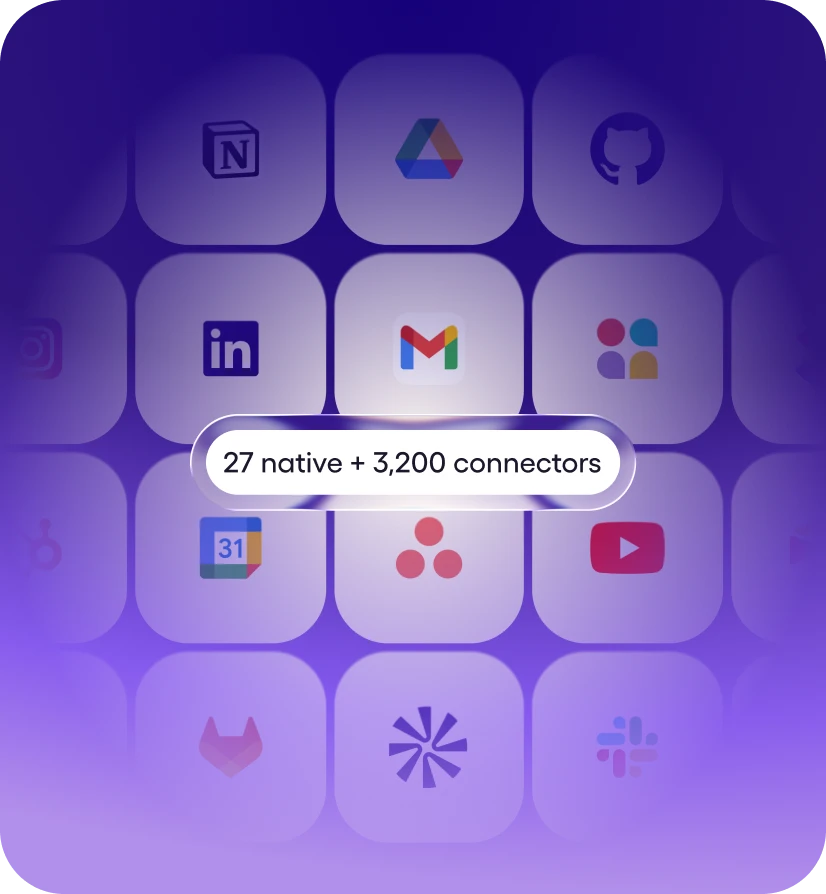
27 native integrations. 3,200+ tools via managed connectors. Most are one-click OAuth, some use API keys - Viktor handles auth and starts working. No webhooks, no Zapier zaps.
Viktor is an AI employee that connects to Facebook in one click via OAuth and helps you schedule social posts and track engagement, running 43 Facebook actions for you like Get Post, Create Post, and Delete Post. Ask in plain English in Slack or Microsoft Teams; Viktor does the work in Facebook and reports back. Setup takes about two minutes.
Free to start · No credit card · SOC 2 Type 1 · Works in Slack & Microsoft Teams
Messages you'd actually send. Paste one into Slack or Microsoft Teams, swap in your specifics, and Viktor takes it from there.
“Schedule next week's posts in Facebook from this content calendar.”
— you, in Slack or Teams
“Pull last week's engagement stats from Facebook and post a summary every Monday.”
— you, in Slack or Teams
“Find our best-performing post in Facebook this month and suggest three follow-ups.”
— you, in Slack or Teams
“Watch Facebook for a spike in mentions and alert me with the context.”
— you, in Slack or Teams
Ask in plain English in Slack or Microsoft Teams. Viktor picks the right Facebook actions, runs the work, and reports back. No workflows to build.
Assigns tasks/roles to a business-scoped user or system user for a specific Facebook Page. Important: This action requires a business-scoped user ID or system user ID from Facebook Business Manager. Regular Facebook user IDs cannot be used. The page must also be managed through Facebook Business Manager for this action to work. Required permissions: businessmanagement, pagesmanagemetadata.
Creates a comment on a Facebook post or replies to an existing comment.
Creates a new photo album on a Facebook Page. Note: This endpoint requires the 'pagesmanageposts' permission or equivalent permissions to be granted to your Facebook application. This action is publicly visible on the Page; confirm with the user before calling.
Creates a photo post on a Facebook Page. Requires an image to be provided via either 'url' (publicly accessible image URL) or 'photo' (local image file upload). This action is specifically for posting images with optional captions, not text-only posts. Returns a composite postid (PageIDPostID); use this for follow-up operations, not the photo/media id alone.
Creates a new text or link post on a Facebook Page. Requires pagesmanageposts permission and manage-level Page role on the target Page. For image posts use FACEBOOKCREATEPHOTOPOST; for video posts use FACEBOOKCREATEVIDEOPOST — media fields are not supported here. Returns a composite post ID in PageIDPostID format, required for FACEBOOKGETPOST retrieval.
Creates a video post on a Facebook Page. Requires a Page access token with pagesmanageposts scope and manage-level permissions on the target page.
Deletes a Facebook comment. Requires a Page Access Token with appropriate permissions for comments on Page-owned content. The pageid parameter helps ensure the correct page token is used for authentication.
Permanently deletes a Facebook Page post. Deletion is irreversible — deleted posts cannot be recovered. For bulk deletions, keep throughput to ~1 delete/second to avoid Graph API rate limits.
Retrieves details of a specific Facebook comment.
Retrieves comments from a Facebook post or comment (for replies). This endpoint requires appropriate permissions: - For page-owned posts: A Page Access Token with 'pagesreadengagement' permission - The API automatically swaps user tokens for page tokens when available API Version: Uses v23.0 which was released May 2025.
Retrieves messages from a specific conversation.
Validates the access token and retrieves the authenticated user's own profile via /me. Cannot fetch arbitrary users by name or ID.
Retrieves details of a specific message sent or received by the Page.
Retrieves a list of conversations between users and the Page.
Fetches details about a specific Facebook Page.
Retrieves analytics and insights for a Facebook Page. Returns metrics like impressions, page views, fan counts, and engagement data. Empty objects ({}) in results indicate missing data, not zero values. High-volume calls risk Graph API rate limits (error codes 4/613).
Retrieves photos from a Facebook Page. CDN-based URLs (including source) are time-limited and expire; download and persist images promptly if long-term access is needed.
Retrieves posts from a Facebook Page. Endpoint choice: Uses /{pageid}/feed instead of /posts or /publishedposts because: - /feed returns all content on page timeline (page's posts + visitor posts + tagged posts) - /posts returns only posts created by the page itself - /publishedposts returns only published posts by the page (excludes scheduled/unpublished) The /feed endpoint provides the most comprehensive view of page activity. Pagination: follow paging.cursors.after or paging.next across multiple calls until no next cursor exists. Throttling: high-volume pagination can trigger Graph API errors 4 and 613; use backoff between requests. API Version: Uses v23.0 (released May 2025). v20.0 and earlier will be deprecated by Meta.
Retrieves a list of people and their tasks/roles on a Facebook Page. The connected account must have management access to the target Page; otherwise the response may be empty or incomplete. Returned role types include MANAGE and CREATECONTENT — verify these before calling tools like FACEBOOKUPDATEPAGESETTINGS. Recently changed roles may take time to propagate; retry if role data appears stale after an update.
Retrieves posts where a Facebook Page is tagged or mentioned. Use when monitoring brand mentions or tracking posts that tag your Page but don't appear on your Page's own feed.
Retrieves videos from a Facebook Page.
Retrieves details of a specific Facebook post.
Retrieves analytics and insights for a specific Facebook post. Returns metrics like impressions, clicks, and engagement data. Very new posts may return empty metric values; allow a short delay before querying and treat absent fields as partial data.
Retrieves reactions (like, love, wow, etc.) for a Facebook post. Very recent posts may return empty or partial reactions data; treat missing fields as incomplete coverage, not an error.
Retrieves scheduled and unpublished posts for a Facebook Page. Results are cursor-paginated; follow pagination cursors to retrieve all results beyond the limit. When searching for posts near a specific time, filter to a narrow (~±5 minutes) window. Use this tool to check for existing entries before scheduling new posts to avoid duplicates.
DEPRECATED: Use FACEBOOKLISTMANAGEDPAGES instead. Retrieves Facebook Pages the user manages (excludes personal profiles, groups, and non-Page entities); an empty data array means no manageable Pages exist. Requires pagesshowlist scope; missing scopes yield empty data or OAuthException code 200. Results paginate ~100 items per page — follow paging.cursors.after or next until exhausted.
Adds a LIKE reaction to a Facebook post or comment. Note: Due to API limitations, only LIKE reactions can be added programmatically. This action is user-visible and irreversible — confirm with the user before calling.
Retrieves a list of Facebook Pages that the user manages (not personal profiles), including page details, access tokens, and tasks. Requires pagesshowlist or pagesreadengagement OAuth scopes; missing scopes silently return empty results rather than an error. An empty data array means the user manages no Pages. Results are paginated via paging.cursors; follow paging.next until absent to retrieve all Pages when count exceeds limit. Graph API throttling (error codes 4, 17, 613) can occur during pagination — use exponential backoff.
Marks a user's message as seen by the Page, visibly updating the read status in the user's conversation. Note: This action requires an active messaging session with the user. Facebook's messaging policy requires that users have messaged the Page within the last 24 hours for sender actions to work.
Publishes a previously scheduled or unpublished Facebook post immediately. This action takes a scheduled or unpublished post and publishes it immediately by setting ispublished to true. The post must have been previously created with published=false or with a scheduledpublishtime. Requirements: - The post must exist and be in an unpublished/scheduled state - The user must have admin access to the page that owns the post - The app must have pagesmanageposts permission.
Removes a user's tasks/access from a specific Facebook Page. Caller must have admin-level rights on the Page. Operates on one pageid at a time; repeat for each page if removing from multiple pages. Partial access may remain if only some tasks are revoked.
Changes the scheduled publish time of an unpublished Facebook post. This action updates the scheduledpublishtime of a previously scheduled post. The post must have been created with published=false and a scheduledpublishtime.
Searches for Facebook Pages based on a query string. Returns pages matching the search criteria with requested fields. DEPRECATION WARNING: The /pages/search endpoint was deprecated by Facebook in 2019 and is now ONLY available to Workplace by Meta apps. Standard Facebook apps will receive Error #10 (permission error) regardless of which permissions or features have been granted. For Workplace apps only - requires one of: - 'pagesreadengagement' permission - 'Page Public Content Access' feature - 'Page Public Metadata Access' feature Standard Facebook apps should use alternative methods to discover pages, such as: - Direct page ID lookup via /{page-id} endpoint - User's managed pages via /me/accounts endpoint Reference: Results include only Facebook Pages; personal profiles, groups, and other entity types are excluded.
Sends a media message (image, video, audio, or file) from the Page to a user.
Sends a text message from a Facebook Page (not personal profiles) to a user via Messenger. Requires explicit user confirmation before calling, as this action delivers a message to a real end user.
Shows or hides the typing indicator for a user in Messenger.
Removes a like from a Facebook post or comment.
Updates an existing Facebook comment. IMPORTANT: This action requires a Page Access Token. The comment must belong to a post on a Page that you manage. Use the pageid parameter to ensure the correct page token is used, especially if you manage multiple pages.
Updates settings for a specific Facebook Page. Requires the authenticated user to have MANAGE and CREATECONTENT tasks for the target page; verify roles via FACEBOOKGETPAGEROLES. Not all fields (about, description, generalinfo, etc.) are available for every Page category.
Updates an existing Facebook Page post.
DEPRECATED: Use FACEBOOKCREATEPHOTOPOST instead. Uploads a photo file directly to a Facebook Page. Supports local file upload up to 10MB.
Uploads multiple photo files in batch to a Facebook Page or Album. Uses Facebook's batch API for efficient multi-photo upload. Maximum 50 photos per batch.
DEPRECATED: Use CreateVideoPost instead. Uploads a video file directly to a Facebook Page. Supports local file upload. For large videos (>100MB), uses resumable upload. After upload completes, the video enters a processing/pending state; do not reference or schedule it until processing finishes.

27 native integrations. 3,200+ tools via managed connectors. Most are one-click OAuth, some use API keys - Viktor handles auth and starts working. No webhooks, no Zapier zaps.

Message Viktor in Slack like you'd message a teammate. "Schedule next week's posts in Facebook from this content calendar." "Pull last week's engagement stats from Facebook and post a summary every Monday." Plain English, any tool.
Viktor opens Facebook, runs the work, and posts back what changed. Sensitive actions wait for your approval. Everything is logged. You stop doing the work and start reviewing it.
A Facebook AI agent is an AI that connects to your Facebook account and completes work in it - it doesn't just answer questions about Facebook, it takes the actions. Viktor is that agent: an AI employee that works in Facebook on your behalf and delivers the finished result in Slack or Microsoft Teams.
Unlike workflow builders such as Zapier or Make, there is nothing to configure - no triggers to map, no workflows to maintain. You describe the outcome in plain English, and Viktor picks the right Facebook actions, chains them with the other 3,200+ tools it connects to, and asks for approval before anything sensitive runs.
Facebook is a social media and advertising platform used by individuals and businesses to connect, share content, and promote products or services. Only supports Facebook Pages, not Facebook Personal accounts.

One-click OAuth - Viktor never sees your password, and you can revoke access at any time.
Review-first approvals: sensitive Facebook actions wait for your sign-off before they run.
Isolated compute per team, encrypted in transit and at rest - and your data is never used to train models.
SOC 2 Type 1 compliant, with Type 2 and ISO 27001 in progress.
Yes. Facebook is one of the 3,200+ tools Viktor connects to, via a managed connector. Once connected, anyone on your team can put Viktor to work in Facebook from Slack or Microsoft Teams - no workflow builder, no code.