Connect your stack
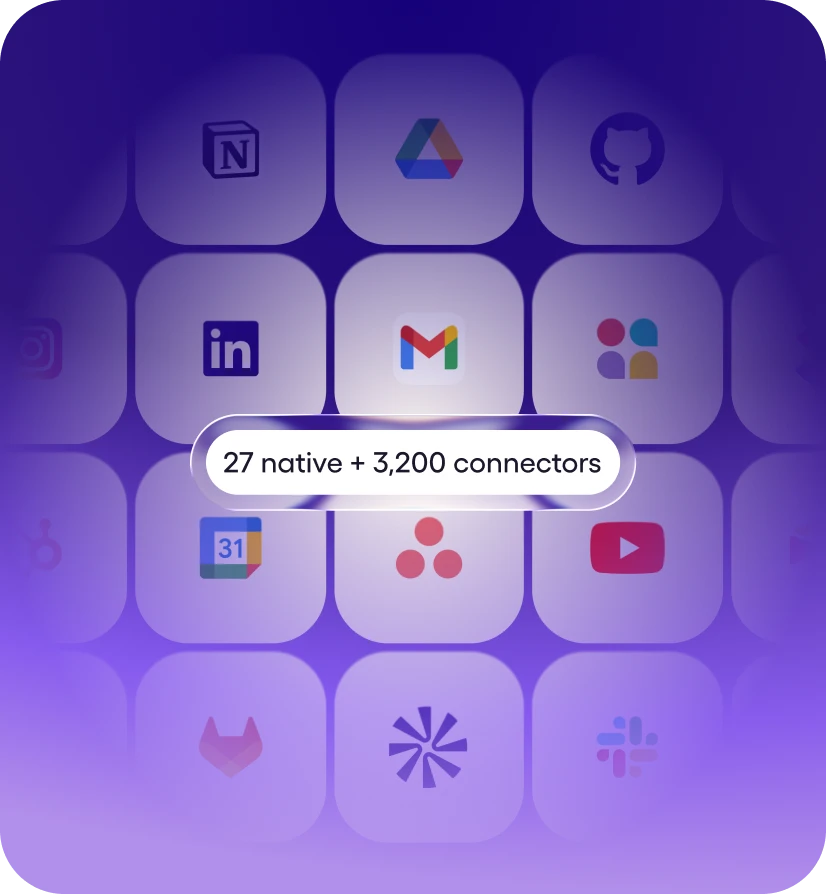
27 native integrations. 3,200+ tools via managed connectors. Most are one-click OAuth, some use API keys - Viktor handles auth and starts working. No webhooks, no Zapier zaps.
Viktor is an AI employee that connects to Google BigQuery in one click via OAuth and helps you query and maintain application databases, running 62 Google BigQuery actions for you like Query, Get BigQuery Job, and List BigQuery Jobs. Ask in plain English in Slack or Microsoft Teams; Viktor does the work in Google BigQuery and reports back. Setup takes about two minutes.
Free to start · No credit card · SOC 2 Type 1 · Works in Slack & Microsoft Teams
Messages you'd actually send. Paste one into Slack or Microsoft Teams, swap in your specifics, and Viktor takes it from there.
“Query Google BigQuery for last month's signups and summarize the trend.”
— you, in Slack or Teams
“Check Google BigQuery for slow queries this week and flag the worst offenders.”
— you, in Slack or Teams
“Sync new records from Google BigQuery into a sheet every morning.”
— you, in Slack or Teams
“Watch Google BigQuery for a spike in errors and alert me with the likely cause.”
— you, in Slack or Teams
Ask in plain English in Slack or Microsoft Teams. Viktor picks the right Google BigQuery actions, runs the work, and reports back. No workflows to build.
Tool to cancel a running BigQuery job. This call returns immediately, and you need to poll for the job status to see if the cancel completed successfully. Note that cancelled jobs may still incur costs.
Tool to create a new capacity commitment resource in BigQuery Reservation. Use when you need to purchase compute capacity (slots) with a committed period of usage for BigQuery jobs. Supports various commitment plans (FLEX, MONTHLY, ANNUAL, THREEYEAR) and editions (STANDARD, ENTERPRISE, ENTERPRISEPLUS).
Tool to create a new BigQuery connection to external data sources using the BigQuery Connection API. Use when setting up connections to AWS, Azure, Cloud Spanner, Cloud SQL, Salesforce DataCloud, or Apache Spark.
Tool to create a new Analytics Hub data exchange for sharing BigQuery datasets. Use when you need to set up a container for data sharing with descriptive information and listings.
Tool to create a new listing in a BigQuery Analytics Hub data exchange. Use when you need to share a BigQuery dataset with specific subscribers or make it available for discovery. The dataset must exist and be in the same region as the data exchange.
Tool to create a new BigQuery dataset with explicit location, labels, and description using the BigQuery Datasets API. Use when the workflow needs to set up a staging/warehouse dataset and correctness of region is critical to avoid downstream job location mismatches. Surfaces 409 Already Exists errors cleanly without retrying.
Tool to create a new data policy under a project with specified location using the v2beta1 BigQuery Data Policy API. Use when you need to set up data masking rules or column-level security for sensitive data. The v2beta1 endpoint uses a nested request structure.
Tool to create a new query template in a BigQuery Analytics Hub Data Clean Room (DCR) data exchange. Use when you need to define predefined and approved queries for data clean room use cases. Query templates must be created in DCR data exchanges only.
Tool to create a new BigQuery reservation resource to guarantee compute capacity (slots) for query and pipeline jobs. Use when you need to reserve dedicated compute resources for predictable performance and cost management. Reservations can be configured with autoscaling, concurrency limits, and edition-based features.
Tool to create a BigQuery reservation assignment that allows a project, folder, or organization to submit jobs using slots from a specified reservation. Use when setting up resource allocation for BigQuery workloads. Note: A resource can only have one assignment per (jobtype, location) combination.
Tool to create a new user-defined routine (function or procedure) in a BigQuery dataset. Use when you need to define SQL, JavaScript, Python, Java, or Scala functions/procedures for reusable logic, data transformations, or custom masking. Supports scalar functions, table-valued functions, procedures, and aggregate functions with comprehensive type definitions.
Tool to create a new, empty table in a BigQuery dataset. Use when setting up data infrastructure for standard tables, external tables, views, or materialized views. Supports partitioning, clustering, and encryption configuration.
Tool to delete a BigQuery dataset specified by datasetId via the datasets.delete API. Before deletion, you must delete all tables unless deleteContents=True is specified. Use when cleaning up test datasets or removing unused data warehouses. Immediately after deletion, you can create another dataset with the same name.
Tool to delete the metadata of a BigQuery job. Use when you need to remove job metadata from the system. If this is a parent job with child jobs, metadata from all child jobs will be deleted as well.
Tool to delete a BigQuery ML model from a dataset. Use when you need to remove a trained machine learning model permanently. The operation deletes the model and cannot be undone.
Tool to delete a BigQuery routine by its ID. Use when you need to remove a stored procedure, user-defined function, or table function from a dataset. This operation is irreversible.
Tool to delete a BigQuery table from a dataset. Use when you need to remove a table and all its data permanently. The operation deletes all data in the table and cannot be undone.
Tool to retrieve a specific BigQuery ML model resource by model ID. Use when you need detailed information about a trained machine learning model including its configuration, training runs, hyperparameters, and evaluation metrics.
Tool to get the IAM access control policy for a BigQuery connection resource. Returns an empty policy if the resource exists but has no policy set. Use this to check who has access to a specific connection before modifying permissions.
Tool to retrieve BigQuery dataset metadata including location via the datasets.get API. Use this before creating jobs/queries if the workflow has been failing with location mismatch to confirm the dataset's region and correct the job location accordingly.
Tool to retrieve information about a specific BigQuery job. Returns job configuration, status, and statistics. Use this to check job status after running queries or to get details about job execution.
Tool to get the results of a BigQuery query job via RPC. Use this to retrieve results after running a query, or to check job completion status and fetch paginated results.
Tool to retrieve a BigQuery routine (user-defined function or stored procedure) by its ID. Use to inspect routine definitions, arguments, return types, and metadata.
Tool to retrieve the IAM access control policy for a BigQuery routine resource. Returns an empty policy if the routine exists but has no policy set. Use this to check current access permissions before modifying them.
Tool to get the service account for a project used for interactions with Google Cloud KMS. Use when you need to retrieve the BigQuery service account email for KMS encryption configuration or key access permissions.
Tool to retrieve the IAM access control policy for a BigQuery table resource. Returns an empty policy if the resource exists but has no policy set. Use this to check current access permissions before modifying them.
Tool to fetch a BigQuery table's schema and metadata without querying row data. Use before generating SQL queries to avoid column name typos and confirm field types and nullable modes. This is especially useful when INFORMATIONSCHEMA access is restricted.
Tool to stream data into BigQuery one record at a time without running a load job. Use when you need immediate data availability or inserting small batches. Supports row-level deduplication via insertId and error handling via skipInvalidRows.
Tool to start a new asynchronous BigQuery job (query, load, extract, or copy). Use when you need to run a query as a job, load data from Cloud Storage, extract table data to GCS, or copy tables. For dry-run validation without execution, set dryRun to true in configuration.
Tool to start a new BigQuery load job with file upload. Uploads a file (CSV, JSON, etc.) and loads it into a BigQuery table in a single operation. Use when you need to upload data from a local file directly to BigQuery rather than loading from Cloud Storage.
Tool to list all listings in a given Analytics Hub data exchange. Use when you need to discover available data listings within a specific data exchange that can be subscribed to for data sharing.
Tool to list BigQuery connections in a given project and location. Use when you need to discover available external data source connections (Cloud SQL, AWS, Azure, Spark, etc.) configured for BigQuery.
Tool to list all capacity commitments for the admin project. Use when you need to view purchased compute capacity slots and their commitment details (plan, state, duration).
Tool to list all listings in a given Analytics Hub data exchange using the v1beta1 API. Use when you need to discover available data listings within a specific data exchange that can be subscribed to for data sharing.
Tool to list datasets in a specific BigQuery project, including dataset locations. Use after identifying an accessible project to discover available datasets and their locations before querying. The dataset location is critical for avoiding location-related query/job errors.
Tool to list all jobs that you started in a BigQuery project. Job information is available for a six month period after creation. Jobs are sorted in reverse chronological order by creation time. Use to monitor query execution, track job statuses, and retrieve job history.
Tool to list information about supported locations for BigQuery Data Transfer Service. Use when you need to discover available regions/locations where BigQuery Data Transfer operations can be performed.
Tool to list BigQuery connections in a given project and location using the v1beta1 API. Use when you need to discover available external data source connections (Cloud SQL, AWS, Azure, Spark, etc.) configured for BigQuery in a specific location.
Tool to list all data policies in a specified parent project and location using the v2beta1 API. Use when you need to discover data masking policies and column-level security policies configured for BigQuery datasets.
Tool to list all BigQuery ML models in a specified dataset. Requires READER dataset role. Use this to discover available models before getting detailed information via models.get method.
Tool to list all data exchanges from projects in a given organization and location using Analytics Hub API. Use when you need to discover available data exchanges within an organization that can be used for data sharing.
Tool to list BigQuery projects to which the user has been granted any project role. Returns projects with at least READ access. For enhanced capabilities, consider using the Resource Manager API.
Tool to list all query templates in a given Analytics Hub data exchange. Use when you need to discover available query templates that define predefined and approved queries for data clean room use cases.
Tool to list BigQuery reservation assignments. Only explicitly created assignments will be returned (no expansion or merge happens). Use wildcard "-" in parent path to list assignments across all reservations in a location.
Tool to list all BigQuery reservation groups for a project in a specified location. Use when you need to discover available reservation groups which serve as containers for reservations.
Tool to list all BigQuery reservations for a project in a specified location. Use when you need to discover available reservations or view reservation details including slot capacity and autoscale configuration.
Tool to list all routines (user-defined functions and stored procedures) in a BigQuery dataset. Requires the READER dataset role. Use this to discover available routines before executing or inspecting them.
Tool to list all row access policies on a specified BigQuery table. Use when you need to discover which row-level security policies are applied to a table and their filter predicates.
Tool to list the content of a BigQuery table in rows via the REST API. Use this to retrieve actual data from a table without writing SQL queries. Returns paginated results with row data in the native BigQuery format.
Tool to list tables in a BigQuery dataset via the REST API. Use this early in exploration to discover accessible tables without relying on INFORMATIONSCHEMA, especially when SQL-based metadata queries are blocked or restricted. This provides a deterministic inventory of tables even when dataset-level permissions prevent INFORMATIONSCHEMA access.
Tool to update an existing BigQuery dataset using RFC5789 PATCH semantics. Only replaces fields provided in the request, leaving other fields unchanged. Use when you need to modify dataset properties like description, labels, expiration settings, or access controls without affecting other configuration.
Tool to update specific fields in an existing BigQuery ML model using PATCH semantics. Use when you need to modify model metadata like description, friendly name, labels, or expiration time without replacing the entire model resource.
Tool to update specific fields in an existing BigQuery table using RFC5789 PATCH semantics. Only the fields provided in the request are updated; unspecified fields remain unchanged. Use when you need to modify table metadata like description, friendly name, labels, or expiration time without replacing the entire table resource.
Query Tool runs a SQL query in BigQuery using the REST API. Use proper BigQuery SQL syntax, e.g., SELECT FROM project.dataset.table WHERE columnname = 'value'. Results are returned under data.rows; an empty rows array means no matching data. Large result sets may be returned via remotefileinfo instead of inline rows. Verify exact projectid, dataset, table, and column names before running; wrong identifiers trigger invalidQuery or notFound errors.
Tool to search all BigQuery reservation assignments for a specified resource in a particular region. Use when you need to find assignments for a project, folder, or organization. Returns assignments created on the resource or its closest ancestor, covering all JobTypes.
Tool to set the IAM access control policy for a BigQuery routine resource. Use this to grant or modify access permissions for users, service accounts, or groups. Include the etag from getIamPolicy to prevent concurrent modifications.
Tool to test which IAM permissions the caller has on a BigQuery routine. Returns the subset of requested permissions that the caller actually has. Use to verify access before performing operations.
Tool to undelete a BigQuery dataset within the time travel window. If a deletion time is specified, the dataset version deleted at that time is undeleted; otherwise, the most recently deleted version is restored.
Tool to update a specified BigQuery connection using the BigQuery Connection API. Use when you need to modify connection properties such as friendly name, description, or connection-specific settings. For security reasons, credentials are automatically reset if connection properties are included in the update mask.
Tool to update information in an existing BigQuery dataset using the PUT method. The update method replaces the entire dataset resource, whereas the patch method only replaces fields that are provided in the submitted dataset resource. Use when you need to modify dataset properties like description, access controls, or default settings.
Tool to update an existing BigQuery routine (function or stored procedure). This replaces the entire routine resource with the provided definition. Use when modifying routine logic, arguments, return types, or other configuration. Ensure all required fields are provided as this is a full replacement operation.
Tool to update an existing BigQuery table. The update method replaces the entire Table resource, whereas the patch method only replaces fields that are provided. Use when you need to modify table properties like schema, description, labels, partitioning, or clustering configuration.

27 native integrations. 3,200+ tools via managed connectors. Most are one-click OAuth, some use API keys - Viktor handles auth and starts working. No webhooks, no Zapier zaps.
Message Viktor in Slack like you'd message a teammate. "Query Google BigQuery for last month's signups and summarize the trend." "Check Google BigQuery for slow queries this week and flag the worst offenders." Plain English, any tool.
Viktor opens Google BigQuery, runs the work, and posts back what changed. Sensitive actions wait for your approval. Everything is logged. You stop doing the work and start reviewing it.
A Google BigQuery AI agent is an AI that connects to your Google BigQuery account and completes work in it - it doesn't just answer questions about Google BigQuery, it takes the actions. Viktor is that agent: an AI employee that works in Google BigQuery on your behalf and delivers the finished result in Slack or Microsoft Teams.
Unlike workflow builders such as Zapier or Make, there is nothing to configure - no triggers to map, no workflows to maintain. You describe the outcome in plain English, and Viktor picks the right Google BigQuery actions, chains them with the other 3,200+ tools it connects to, and asks for approval before anything sensitive runs.
Google BigQuery is a fully managed data warehouse for large-scale data analytics, offering fast SQL queries and machine learning capabilities on massive datasets

One-click OAuth - Viktor never sees your password, and you can revoke access at any time.
Review-first approvals: sensitive Google BigQuery actions wait for your sign-off before they run.
Isolated compute per team, encrypted in transit and at rest - and your data is never used to train models.
SOC 2 Type 1 compliant, with Type 2 and ISO 27001 in progress.
Yes. Google BigQuery is one of the 3,200+ tools Viktor connects to, via a managed connector. Once connected, anyone on your team can put Viktor to work in Google BigQuery from Slack or Microsoft Teams - no workflow builder, no code.