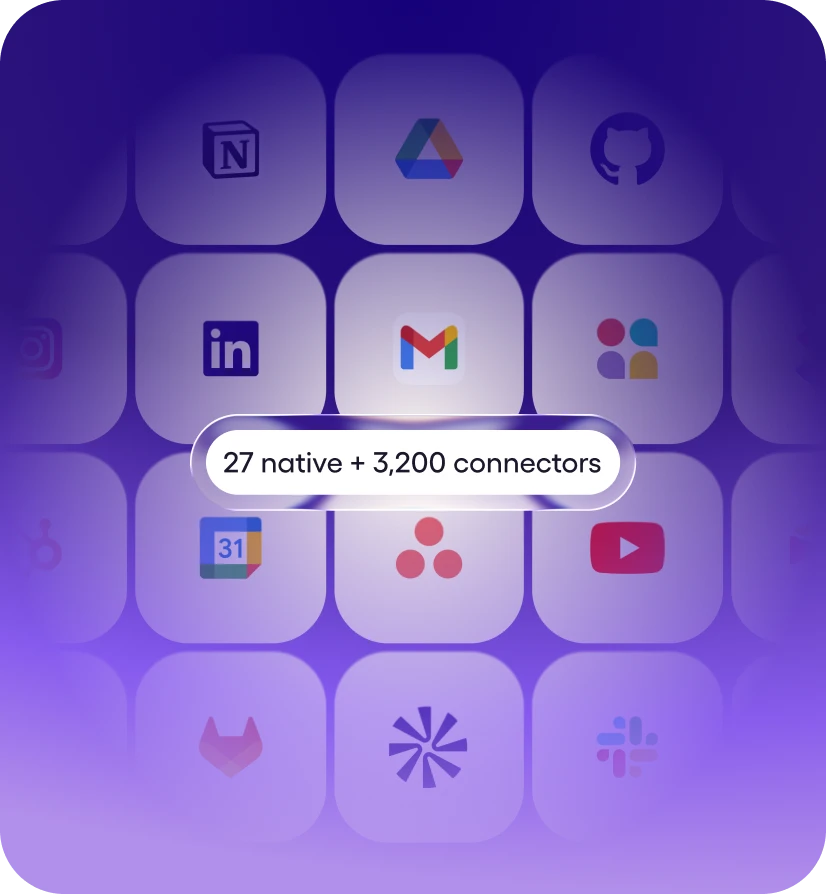
Step 1: Connect your stack
27 native integrations. 3,200+ tools via managed connectors. Most are one-click OAuth, some use API keys - Viktor handles auth and starts working. No webhooks, no Zapier zaps.


Viktor is an AI employee that connects to PagerDuty and helps you monitor application errors and incidents, running 31 PagerDuty actions for you like List Users, List Teams, and Get Incident. Ask in plain English from your workspace; Viktor does the work in PagerDuty and reports back. Viktor connects in one click via OAuth.
A PagerDuty AI agent is an AI that connects to your PagerDuty account and completes work in it - it doesn't just answer questions about PagerDuty, it takes the actions. Viktor is an AI employee that works in PagerDuty on your behalf and delivers the finished result to your workspace.
Unlike workflow builders such as Zapier or Make, there is nothing to configure - no triggers to map, no workflows to maintain. You describe the outcome in plain English, and Viktor picks the right PagerDuty actions, chains them with the other 3,200+ tools it connects to, and asks for approval before anything sensitive runs.
About PagerDuty
Real-Time Operations and Incident Response

You ask in your workspace
Describe what you need in plain English

Viktor picks the actions
Selects from 31 PagerDuty actions, chains them together

Runs in PagerDuty
Helps you monitor application errors and incidents - your real data.
Reports back
Delivers the finished result to your workspace
Messages you'd actually send. Paste one into your workspace, swap in your specifics, and Viktor takes it from there.
“Summarize the new errors in PagerDuty from the last 24 hours and flag any regressions.”
— you, to @Viktor
“Check PagerDuty for the root cause of last night's incident and report back.”
— you, to @Viktor
“Watch PagerDuty for a new critical alert and page me immediately.”
— you, to @Viktor
“Post a summary of this week's PagerDuty incident count to #eng every Friday.”
— you, to @Viktor
27 native integrations. 3,200+ tools via managed connectors. Most are one-click OAuth, some use API keys - Viktor handles auth and starts working. No webhooks, no Zapier zaps.
Message Viktor in Slack like you'd message a teammate. "Reconcile this month's invoices and flag anything weird." "Pause Meta campaigns above $40 CPA and move the budget to winners." Plain English, any tool.
Viktor opens the tools, runs the work, and posts back what changed. Sensitive actions wait for your approval. Everything is logged. You stop doing the work and start reviewing it.
Ask in plain English from your workspace. Viktor picks the right PagerDuty actions, runs the work, and reports back. No workflows to build.
Update an incident's status, title, urgency, priority, escalation policy, or assignments. Use List Incidents or Get Incident to find the incident ID. To acknowledge: set status to acknowledged. To resolve: set status to resolved. Use List Users to find user IDs for assignments and List Priorities for priority IDs.
Update an escalation policy's name, description, loop count, or escalation rules. By default, performs a read-then-merge: fetches the current policy and merges your changes before writing, so you only need to specify the fields you want to change. Set fullReplacement: true to replace all rules wholesale — use with caution as this is destructive. Use List Escalation Policies to find the policy ID. Each escalation rule targets one or more users or schedules: provide targets as an array of objects with id and type (userreference or schedulereference).
Deprecated — use Create Incident instead. Trigger an incident.
Start an automation workflow on an active incident. Use List Incident Workflows to discover available workflow IDs. Use List Incidents or Get Incident to find the incident ID. Requires Business+ plan — accounts without this plan will receive a 402 error.
Deprecated — use Update Incident instead. Resolve an incident.
List users in the PagerDuty account, searchable by name or email. Returns user IDs, names, emails, and roles. Optionally filter by team membership using team IDs from List Teams.
Retrieves available options for the User ID field.
List teams in the PagerDuty account, optionally filtered by name. Returns team IDs and names useful for filtering incidents, users, and services.
List configured PagerDuty status pages. Use status page IDs with List Status Page Posts to retrieve posts on a specific page. Requires Business+ plan — accounts without this plan will receive empty results or a 402 error.
Ask for outcomes that span tools - Viktor pulls from PagerDuty, cross-references the rest of your stack, and delivers one finished result.
Viktor connects to 3,200+ tools and works across them in a single run.
Yes. PagerDuty is one of the 3,200+ tools Viktor connects to, via a managed connector. Once connected, anyone on your team can put Viktor to work in PagerDuty from their workspace - no workflow builder, no code.
One hire. The output of a team.
Viktor works nights, remembers every decision, and connects to 3,200 tools. Start free with $100 in credits, then $50 a month.