
 Written with Viktor
Key Takeaways
- Most underperformance is a setup problem, not a product problem. The AI employee is capable. The workflow around it decides whether it delivers or just sits there.
- Connecting twenty tools on day one overwhelms the agent. Start with three integrations tied to one real workflow, then expand once that workflow runs clean.
- Instructions that live in your head do not exist for the AI. A two-paragraph SOP saved as a skill turns a forgetful assistant into a consistent operator.
- Review-first is a feature, not a limitation. Teams that review the first few outputs catch errors early and build trust fast. Teams that skip review lose trust permanently.
- Recurring workflows separate one-off novelty from daily value. One well-built cron that runs every morning is worth more than fifty ad-hoc questions.
- If none of the above applies, tell support what happened. Some issues are real bugs, and the team fixes them fast when they can reproduce the problem.
You hired an AI employee. You connected your tools. You sent a few messages. And now, three weeks in, you are quietly wondering whether the whole thing was a mistake.
The AI answered a couple of questions. It pulled a report once. But it is not doing real work. Not the kind you imagined when you signed up. Not the kind where you wake up Monday and something you used to do yourself is already done.
We see this pattern constantly. Support tickets that say "he's too dumb" or "he keeps forgetting what I told him" or just "it's not working." When we dig in, the AI employee is almost never broken. The setup around it is.
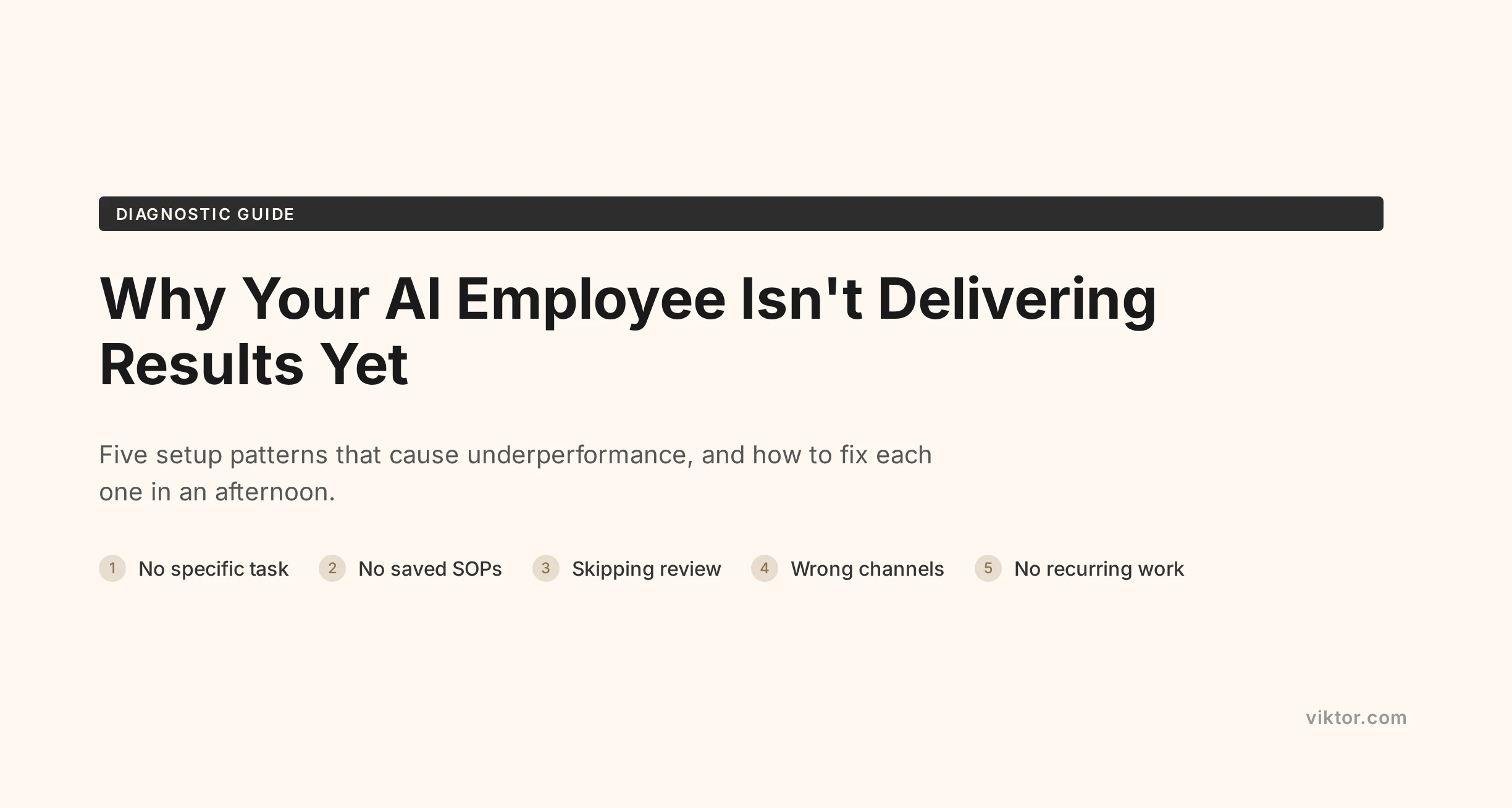
Here are the five patterns we see most often, what they look like from the inside, and how to fix each one in an afternoon.
You connected everything but gave it nothing specific to do
The first instinct is reasonable: connect all your tools so the AI can see everything. Slack, Google Drive, HubSpot, Stripe, Notion, Linear, Gmail, Google Ads, QuickBooks. Twenty integrations on day one.
The problem is not that the AI cannot handle twenty tools. It can. The problem is that you connected twenty tools and then sent a vague message like "help me stay on top of things." That is not a task. That is a hope.
What actually works:
@Viktor Pull our Stripe MRR for this month and last month, compare them, and tell me if any customer's spend changed by more than 20%.That message names one tool (Stripe), one action (compare MRR), and one threshold (20% change). The AI knows exactly what to do. Compare that with "look through all our tools and find anything interesting," which gives the AI no criteria for what "interesting" means.
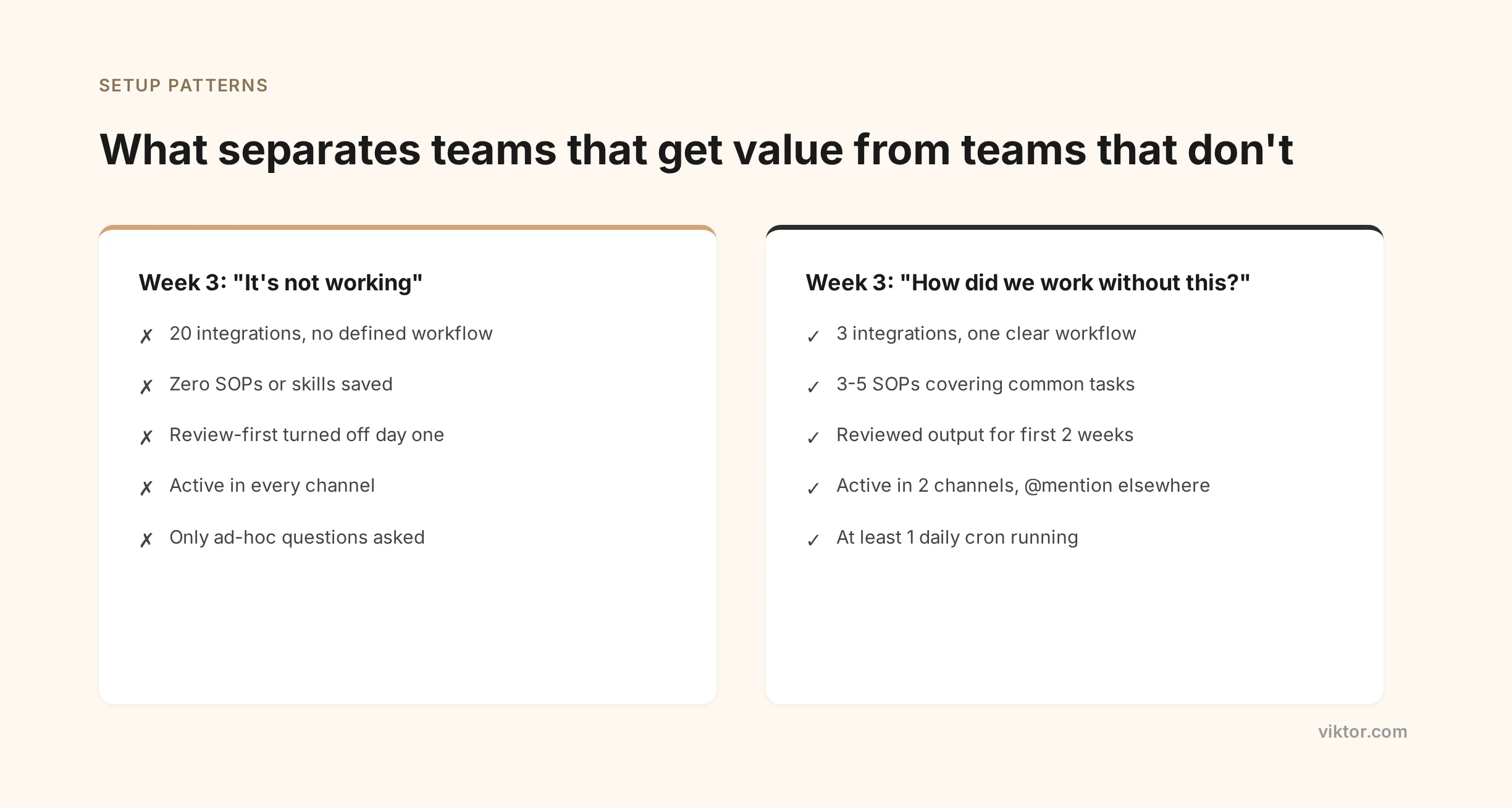
The fix: start with three integrations tied to one workflow you actually do every week. If you run a weekly revenue check, connect Stripe and your spreadsheet tool. If you manage paid ads, connect Google Ads and your reporting destination. Get that workflow working. Add more tools once the first one runs clean.
| Setup pattern | What you get | What to do instead |
|---|---|---|
| 20 tools, no clear task | Generic summaries, slow responses | 3 tools, one real weekly workflow |
| "Help me with everything" | Scattered attempts at everything | "Pull X from Y, compare to Z" |
| All channels, all the time | Noise, wasted credits | 1-2 channels, @mention in others |
Related: How to choose your first three integrations
Your instructions live in your head
This is the single biggest source of the "he keeps forgetting" complaint. You tell the AI employee how you want a report formatted. It does it right. Next week, you ask again, and it formats it differently. You tell it your company's voice for client emails. It nails the first draft. The second draft sounds like a legal brief.
The AI is not forgetting. It never "knew" in the first place. Each conversation is a fresh context window. What you said in a thread two weeks ago does not carry forward automatically unless you save it.
The fix is a skill, which is Viktor's version of an SOP. You write it once, and every future conversation can reference it. Here is what a working skill looks like in practice:
@Viktor Create a skill called "Weekly Revenue Report" with these rules: always pull data from Stripe and Google Sheets. Compare this week vs last week. Flag any customer whose spend dropped more than 15%. Format as a table with customer name, last week, this week, and percentage change. Send results in #finance-updates every Monday at 9 AM.That message takes sixty seconds to write. From that point forward, the AI follows those rules every single time. It does not forget them. It does not drift. If you want to change the threshold from 15% to 10%, you update the skill once.
Teams that write zero skills get an assistant that starts fresh every conversation. Teams that write three to five skills get an employee that operates consistently.
Related: How to write a runbook your AI employee can follow
Nobody is reviewing the output
Viktor runs in review-first mode by default. When it is about to send an email, update a CRM record, or publish something, it shows you a draft and waits for approval. You click approve or reject.
Some teams treat this as friction. They want the AI to "just do it." So they skip the review step, miss an error in the first week, and then lose trust in the tool entirely. One wrong email to a client, one bad number in a report, and the reaction is "this thing can't be trusted."
The irony: review-first exists precisely to prevent that moment.
The teams that get the most value follow a pattern. For the first two weeks, they review everything. They catch one or two errors, correct them, and sometimes save the correction as a skill so it does not happen again. By week three, they trust the AI on routine tasks and only review sensitive ones (external emails, financial data, client-facing reports).
@Viktor When you draft emails to clients, always show me the draft first. When you pull internal Slack summaries, you can post them directly to #team-updates without asking.That is the control spectrum. Full review for external actions, auto-execute for internal ones. You decide where the line is.
The cost of skipping review is not one error. It is the permanent loss of trust that makes you stop using the tool altogether.
Related: How to keep a human in the loop with your AI employee
It is responding where it should not be
You added the AI to your Slack workspace. It now sees every channel it has been invited to. If someone mentions it in #random, it responds. If someone mentions it in #engineering-standup, it responds. If someone asks a rhetorical question in #general and tags it by accident, it responds.
This creates two problems. First, the AI generates noise in channels where people do not want it. Second, every response uses credits, and undirected responses in channels where no one asked for help burn through your allowance.
The fix takes two minutes:
- Decide which channels the AI should actively monitor (usually two or three: a dedicated #viktor channel, your team's working channel, maybe a reporting channel).
- In other channels, set the AI to @mention-only mode. It stays quiet unless someone specifically asks for help.
@Viktor Only respond in #marketing-ops and #weekly-reports without being mentioned. In all other channels, only respond when someone tags you directly.This keeps the AI focused where it adds value and silent everywhere else.
Related: How to control where your AI employee works
You have not set up a single recurring workflow
This is the difference between a tool you tried and an employee you hired. One-off questions are fine for testing. "Summarize this document." "Draft a reply to this email." "What did we discuss in yesterday's meeting?" All useful, all forgettable by next week.
The real value shows up when the AI does something you used to do every day, without you asking. A morning briefing that lands in your channel at 8 AM with yesterday's key numbers. A weekly competitor check that pulls the latest from three industry blogs. A daily CRM hygiene pass that flags stale deals and missing follow-ups.
One cron, running every morning, replaces a task you would otherwise spend twenty minutes on. Over a month, that is seven hours you get back. Over a quarter, twenty-one hours. And unlike a human employee, the cron does not forget, does not take sick days, and does not quietly stop doing the task because something more urgent came up.
@Viktor Every weekday at 8 AM, pull yesterday's Stripe charges and refunds, summarize them in a table, and post to #finance-updates. If any single refund is over $500, flag it separately.If you have been using the AI for three weeks and have not set up a single recurring task, you are treating an employee like a chatbot. The chatbot answers questions. The employee does work while you sleep.
Related: How to set up a recurring task for your AI employee
The diagnostic checklist
Before you decide the AI is not working, run through this in order. Most teams find the answer in the first three rows.
| Check | Question | Fix |
|---|---|---|
| Integrations | Are you using more than 5 tools with no defined workflow? | Pick 3, build one workflow |
| SOPs | Have you saved any skills or SOPs? | Write one for your most common request |
| Review | Are you reviewing output for the first 2 weeks? | Turn review-first on for external actions |
| Channels | Is the AI responding in channels where nobody asked? | Set @mention-only for non-working channels |
| Crons | Do you have at least one recurring task running? | Set up a daily or weekly report |
| Corrections | When it gets something wrong, do you tell it? | Correct in-thread so the fix sticks |
| Support | None of the above? | Message support with what happened |
When it genuinely is a bug
Not every underperformance is a setup issue. Sometimes an integration drops its connection and the AI cannot pull data. Sometimes a tool's API changes and the connector needs an update. Sometimes the AI genuinely misinterprets an instruction in a way that repeating the instruction will not fix.
The difference: a setup issue looks like "it is not doing what I want." A bug looks like "it was doing exactly what I want, and then it stopped, and nothing on my end changed."
If you hit the second scenario, message support with three things: what the AI was doing, when it stopped, and what error (if any) you saw. The team can usually reproduce and fix integration issues within a day.
Frequently Asked Questions
How long should it take before my AI employee is useful?
Most teams that follow the pattern above (three integrations, one SOP, one recurring task) see consistent value within the first week. Teams that skip those steps often spend three weeks wondering why it is not working.
Do I need to be technical to set up skills and crons?
No. Skills are plain-language instructions saved as text. Crons are set up by telling the AI what to do and when. Both use natural language, not code.
Can I start over if my setup is messy?
You can delete existing skills and crons and rebuild from scratch at any time. The AI does not hold grudges. A clean restart with one focused workflow often outperforms three weeks of scattered setup.
How many integrations should I start with?
Three is a good number for the first week. Pick tools you interact with daily (email, CRM, project management, analytics). Once the first workflow runs well, add more.
What if my AI employee is slow to respond?
Response time depends on task complexity and the number of tools involved. A simple Slack summary takes seconds. A multi-tool report with comparisons takes a minute or two. If responses consistently take more than five minutes for simple tasks, contact support.
Does review-first slow down the AI employee?
Review adds one human step to sensitive actions. For internal, low-risk tasks (posting summaries to a team channel, organizing notes), you can set the AI to act without review. Most teams keep review on for anything external.
Why does the AI format things differently each time?
Without a saved skill, each conversation starts fresh. The AI does not remember formatting preferences from previous threads unless you save them as a skill. One SOP with formatting rules solves this permanently.
How do I know if an issue is my setup or a real bug?
If the AI was working correctly and stopped without any changes on your end, it is likely a bug (usually an integration disconnect). If the AI never consistently did what you wanted, it is almost certainly a setup issue.