
 Written with Viktor
Key Takeaways
- The interface language and the work language are two separate settings. Each person picks the language they read the app in. The language of the deliverable belongs in the brief.
- Viktor's app language covers 28 languages, including Español (España) and Español (Latinoamérica) as separate options, set per person in Settings, Personal, App language.
- Write the output language into the recurring brief once, not into every task. "Summary in English, customer replies in the customer's language" is a line in the routine, and it holds after that.
- A mixed-language channel is an input, not a problem. Your ops lead can write in Polish, your CS lead in German, and the Monday report still comes back in one language the whole team reads.
- Check the first run in every language you care about, ideally with a native speaker on the team, then let the routine run. Tone and terminology are where translation slips, not grammar.
- Names, product terms, and legal wording should be pinned in the brief. Left open, they get translated, and that is the mistake customers notice.
The Monday report that arrived in three languages
Our support lead writes in German. The ops person who owns the weekly numbers writes in Polish. The founder reads English and skims everything. For months the Monday summary was assembled by whoever was free, which meant it arrived in whatever language that person thought in, and half the team stopped reading it.
That is a small problem with an expensive shape. The report was fine. The work behind it was fine. It just did not land, so decisions kept getting made from memory instead of from the numbers.
If you work across languages, an AI employee is the rare case where the mixed-language mess becomes an advantage. He reads the channel in whatever language it happens in, and he writes the output in the language you asked for. The part you have to get right is telling him which is which.
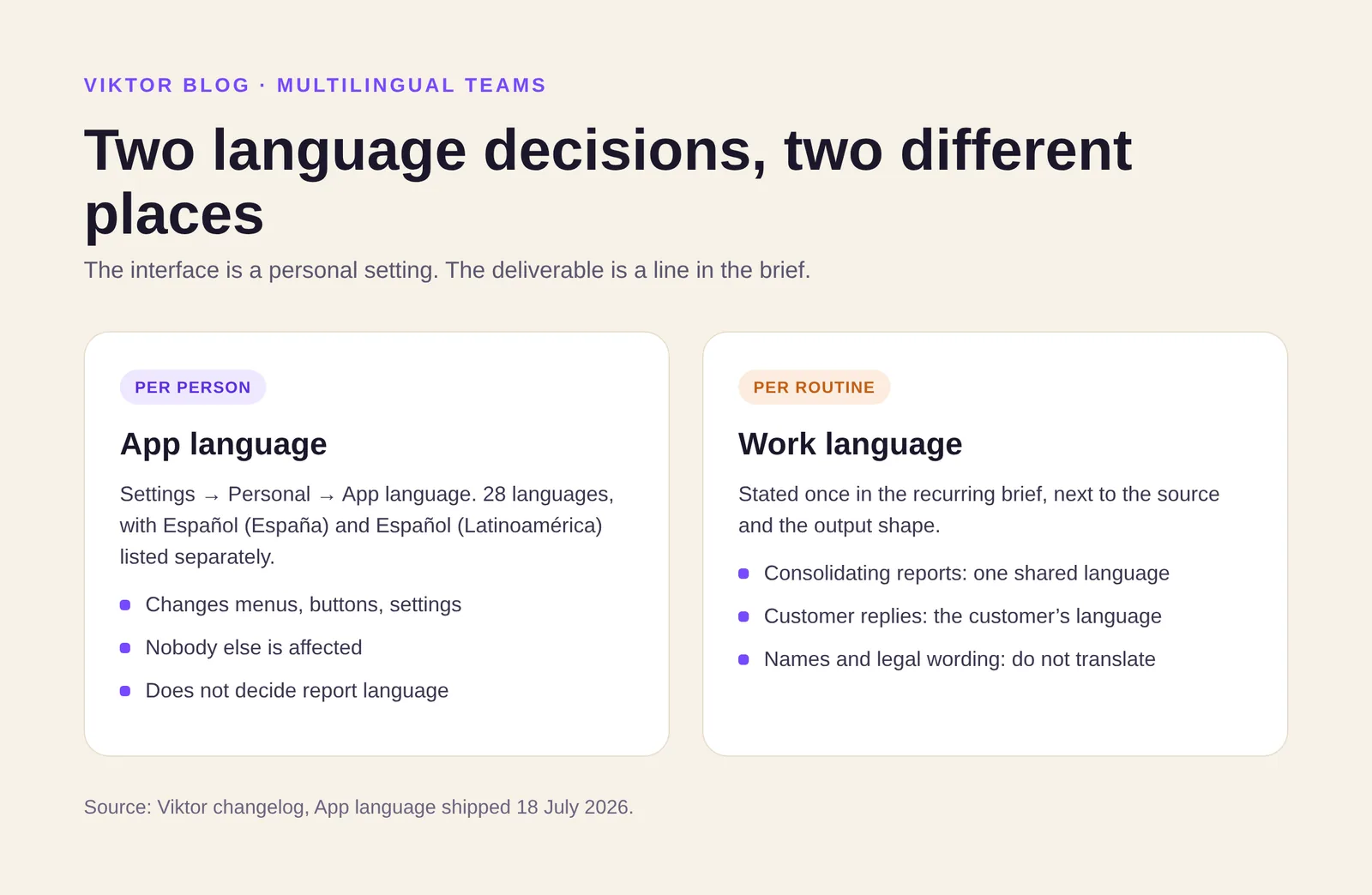
What is a per-person setting and what belongs in the brief?
The interface is a personal preference. The deliverable is a team decision. Keeping those apart is most of the setup.
Viktor's app language shipped on July 18, 2026 with 28 languages, including separate Español (España) and Español (Latinoamérica) options, set under Settings, Personal, App language (see the Viktor changelog). It changes what one person sees in the app. It does not decide what language a report comes back in, and it should not: your Spanish-speaking analyst may still need the board summary in English.
| Decision | Where it lives | Who sets it |
|---|---|---|
| Language of buttons, menus, settings | Settings, Personal, App language | Each person, for themselves |
| Language of the Monday ops report | The recurring task brief | Whoever owns the routine |
| Language of a customer reply | The brief, as a rule ("reply in the customer's language") | Support lead |
| Language of the source data | Nothing, it is whatever it is | Nobody, it is an input |
| Product names and legal wording | Pinned as do-not-translate in the brief | The person accountable for the wording |
The last row is the one teams skip. A German customer email that translates your plan name or your warranty phrasing reads worse than an English reply would have.
How do you write the brief for a multilingual routine?
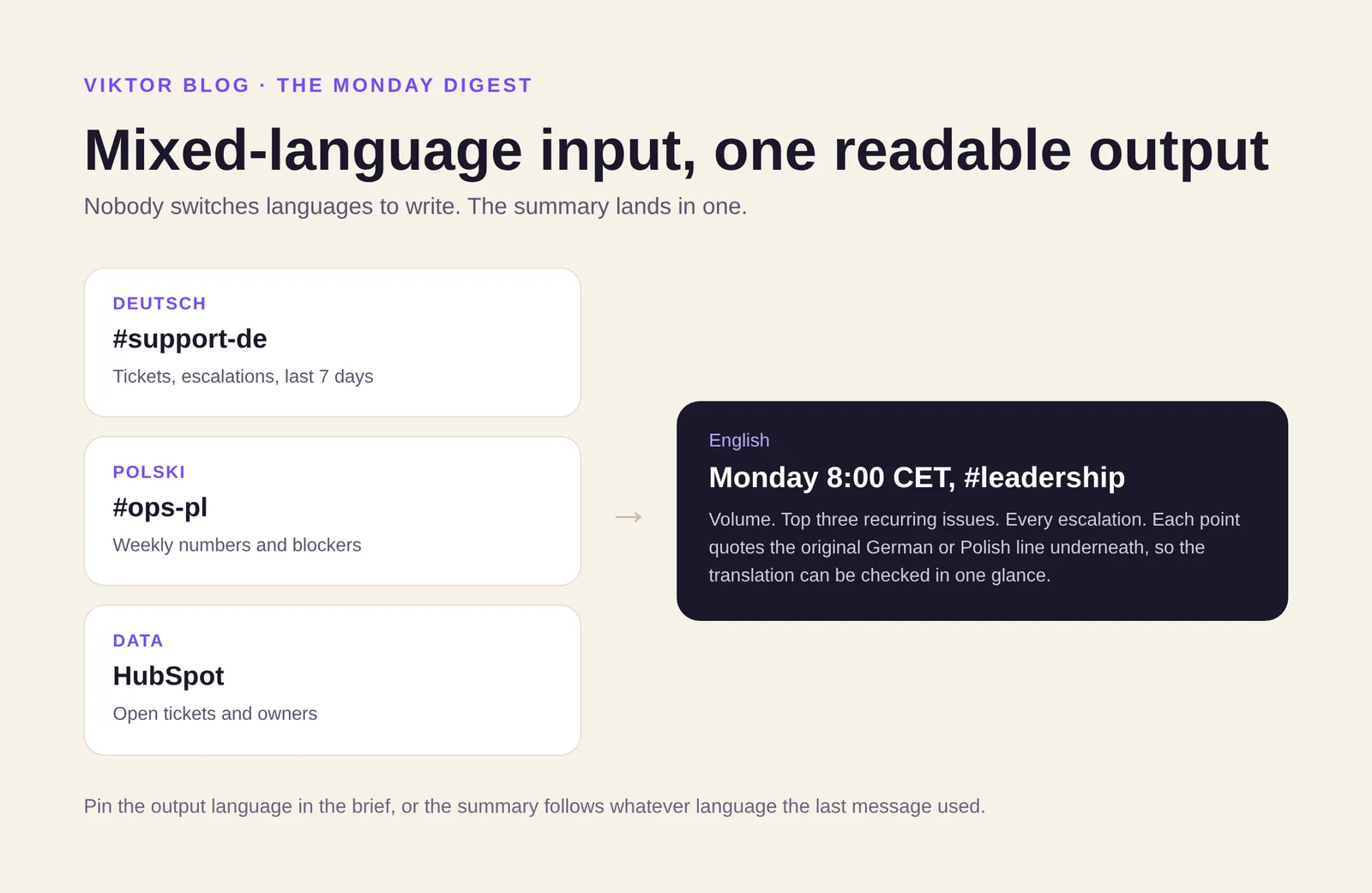
Put the input, the output language, and the exceptions in the same sentence you use to describe the job. Here is the digest that fixed our Monday problem:
Every Monday 8:00 CET, read #support-de and #ops-pl from the last 7 days,
plus open tickets in HubSpot. Post one summary in #leadership in English:
volume, top 3 recurring issues, anything a customer escalated.
Quote the original German or Polish line under each issue so we can check it.
The quote-the-original instruction is the part worth stealing. It gives you a translation you can audit in one glance, which means nobody has to trust the summary blind. More on that pattern in how to verify your AI employee's work.
Customer-facing work needs the opposite default. You are not consolidating into one language, you are matching the person on the other end:
When a support email lands in Zendesk, draft the reply in the language the
customer wrote in. Keep the plan name and the SLA sentence in English exactly
as written in our macro. Hold every draft for review, do not send.
And when a document has two audiences, say so instead of producing one file and translating it later by hand:
Take the Q3 onboarding one-pager in Drive and produce two PDFs: one in English
for the US team, one in Spanish (Latinoamérica) for the Mexico City office.
Same layout, same screenshots, do not translate the product names.
Three different jobs, one pattern: name the source, name the output language, name what must not change.
Where translation actually goes wrong
Grammar is not the failure mode. These are:
- Register. A reply that is correct German but too casual for a bank, or too stiff for a startup. Fix it by telling him whose voice to match, and naming an existing message as the reference.
- Terminology drift. The same feature called three things across three replies. Fix it with a short glossary in the brief, or in Viktor's memory so it survives the next task. See how to give your AI employee memory.
- Names and legal strings. Product names, plan names, contract clauses, and disclaimers should be marked do-not-translate. Nothing else in this list embarrasses you faster.
- Numbers and dates. Decimal commas, thousands separators, and day-month order differ by locale. If a number is going into a customer document, say which locale formats it.
- Silent language switching. A thread starts in English, someone answers in Italian, and the summary follows the last message instead of the rule. Pin the output language in the brief rather than relying on context.
We caught the register problem on the first German draft, not the tenth, because a native speaker on the team read run one. That review took four minutes and it is the entire quality control system for this.
Do you need a separate setup per language?
No, and building one is the mistake worth avoiding. One AI employee, one set of connected tools, one memory, with the language stated per routine. Split him into a German instance and a Polish instance and you get two sets of drifting instructions and two glossaries that disagree by the second month.
The team-level habits are the same ones that keep any shared AI employee sane: one owner per routine, requests in channels rather than DMs, corrections made where everyone can see them. How a team shares one AI employee without chaos covers that structure, and it does not change when you add languages.
What does change: your glossary becomes a real asset. Write down the ten terms your company argues about, with the approved translation for each, and put them where the routine can reach them. That single list removes most of the corrections you would otherwise make weekly.
A setup you can finish this week
- Ask everyone to set their own app language. Settings, Personal, App language. One message in your team channel, done.
- List your recurring reports and pick one output language each. Consolidating reports go to the language leadership reads. Customer-facing work matches the customer.
- Write the glossary. Ten to twenty terms: product names, plan names, the two or three phrases legal cares about. Mark what never gets translated.
- Run each routine once with a native speaker watching. Not the whole batch. One run per language, reviewed by someone who would wince at the wrong register.
- Correct in the thread, not in a doc. A correction made where the work happened sticks to the routine. How to correct your AI employee when it gets something wrong has the mechanics.
Our Monday report is now one English post assembled from two channels nobody writes English in. The German and Polish lines sit quoted underneath, which means the two people who own those areas still recognize their own work in it. That is the whole trick: stop asking people to write in a second language, and start asking for the output in one.
Frequently Asked Questions
How many languages does Viktor's interface support?
28, set per person under Settings, Personal, App language. Spanish is offered as two separate options, Español (España) and Español (Latinoamérica). The setting shipped on July 18, 2026 and is listed in the Viktor changelog.
Does changing my app language change the language of my reports?
No. The app language controls what you see in the interface. The language of a deliverable comes from the task or the recurring brief, which is why a Spanish-speaking analyst can read the app in Spanish and still receive the board pack in English.
Can Viktor read a channel where people write in different languages?
Yes. Mixed-language channels are a normal input. State the output language in the brief so the summary does not follow whichever language the last message happened to be in.
How do I stop product names from being translated?
Name them in the brief as do-not-translate, and keep them in a short glossary Viktor can reference. Do the same for plan names, contract clauses, and any disclaimer legal has approved.
Should I set up a separate AI employee per language or per office?
One is better. A single AI employee keeps one set of connected tools, one memory, and one glossary. Separate setups per language drift apart and double the corrections.
How do I check translation quality without reviewing every task?
Review the first run in each language with a native speaker on the team, then spot-check monthly. Asking him to quote the original line under each translated point makes an audit take seconds instead of minutes.
Does this work in Microsoft Teams as well as Slack?
Yes. Viktor lives in both, and the same brief structure applies. If you are moving between them, moving from Slack to Teams with an AI employee covers what carries over.