Who we are
Written by Artur Wala, co-founder, GTM Tech Week.
GTM Tech Week started as two meetups and grew into a week with 19 events, 40+ speakers, 600+ attendees across those events, an opening panel at Google for Startups Campus, and a sold-out Full Week Pass. It was our first serious event. We had no marketing team, no agency, and roughly eleven working days of serious promotion.
In those 11 days, agents did roughly 80 to 100 hours of work we would otherwise have had to outsource: design, promo planning, coordination between attendees, venues, speakers and partners. Even finding people available on that notice would have been a project. And since it was our first event, we wouldn't even have known how to brief them.
If you're in founder mode running launches, campaigns or events without a marketing team, this is the setup.
I didn't use one magical agent for everything. Viktor lived in Slack, where the work was happening. It held the context, did the research, made the calls on format and copy. When something needed to become a file in a repository, I handed that piece to Codex. I sat in the middle, moving work between them.
- Industry:
- Events / B2B community
- Team:
- 2 co-founders, 0 marketing hires
- Website:
- gtm-week.com
- Time to value:
- Day 1: promo masterplan plus a 57-action tracker built from voice notes
- Timeline:
- Viktor installed Feb 2026 · GTM Tech Week work started Jun 2 · sold out Jun 22
- Scale:
- 19 events · 40+ speakers · 600+ attendees · 303 Viktor messages across 22 threads in the 11 promo days
- Tools connected:
- SlackGoogle SheetsElevenLabsLumaGitHub
Day one: from voice notes to a 57-action tracker
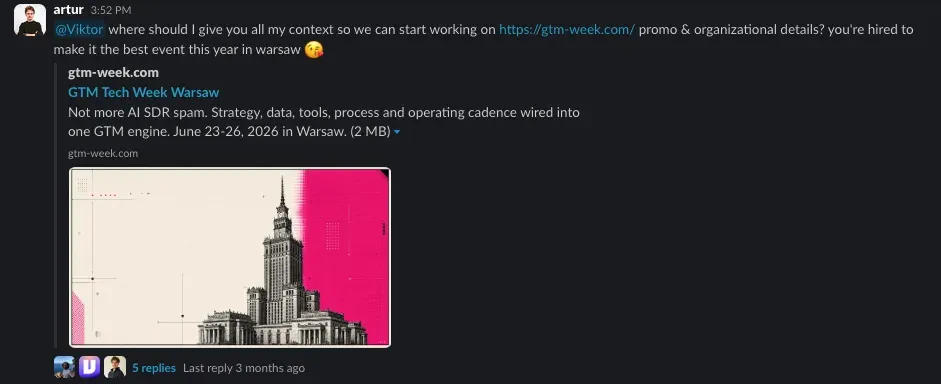
My first instruction to Viktor was not subtle. On June 2 I wrote, in Slack:
“where should I give you all my context so we can start working on gtm-week.com promo & organizational details? you're hired to make it the best event this year in warsaw.”
- Artur, June 2, 3:52 PM
Twenty days later the Full Week Pass was sold out.
I also told him what I did not want: generic marketing advice, or a long brainstorm that would disappear in Slack. I wanted a short masterplan and an exact tracker, day by day, action by action, with dates, owners, and a clear reason each action mattered.
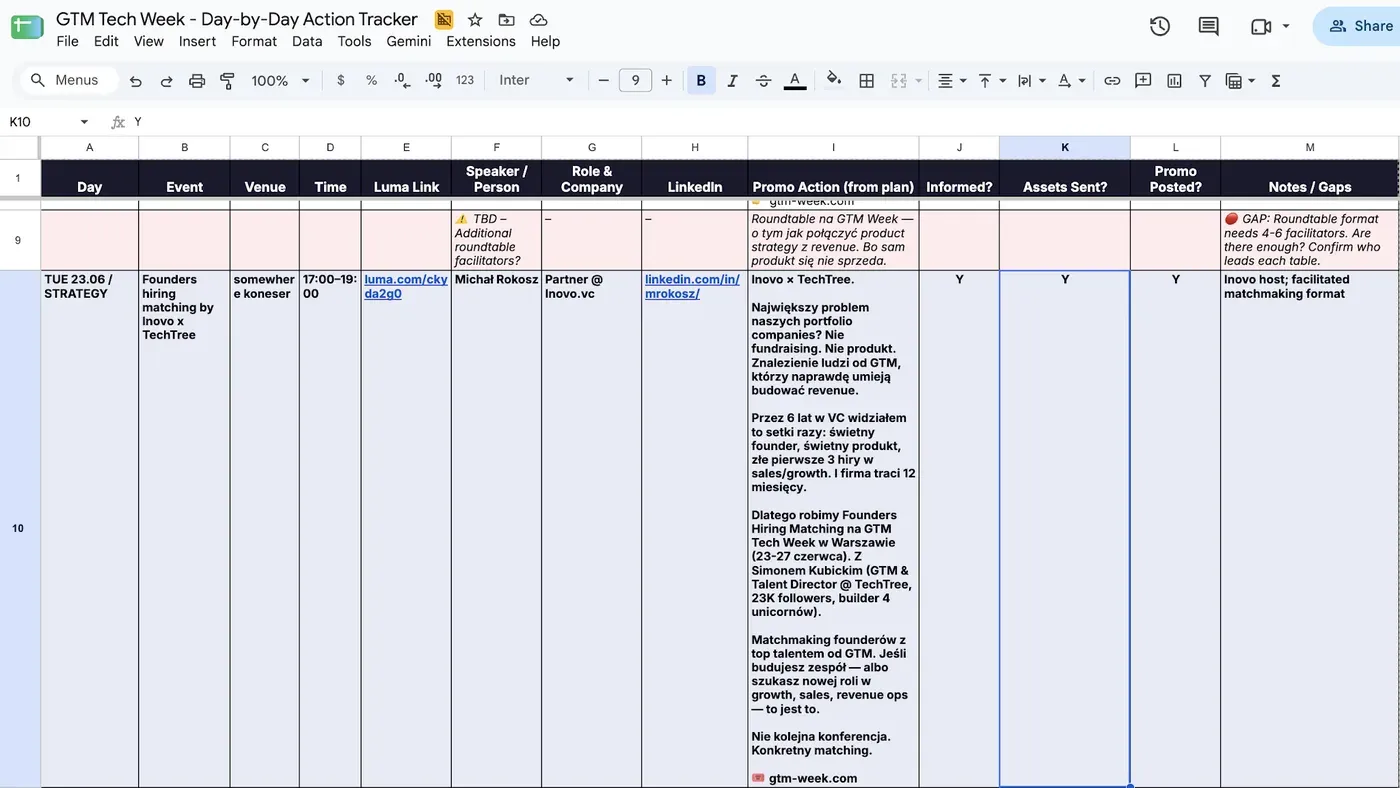
Viktor produced a two-page promo plan and a 57-action tracker, built from my voice notes and scattered documents.
After review (yes, I wanted a human in the loop), I pasted in a separate plan my business partner had made and asked Viktor to assess both. We didn't treat the AI plan as correct by default. We used it as a second opinion, merged the strongest parts, and kept one working system.
We weren't an organized company yet: no CRM, no shared workspace. Viktor managed the whole thing in spreadsheets: statuses, owners, blockers, dependencies. Not another set of ideas, but a place the event could actually be run from, without a single dollar spent on tooling. Organizing that starting point would have taken me four hours of deep work; making it operational, probably another full day.
One tracker for every speaker, and copy written in their voice
As the week expanded, distribution coordination became the hard part. Multiple events, speakers, partners, promotion requests, missing assets, follow-ups. Asking every speaker to "please promote the event" would have been rookie and ineffective. People are busy, and most don't want to write your campaign for you.
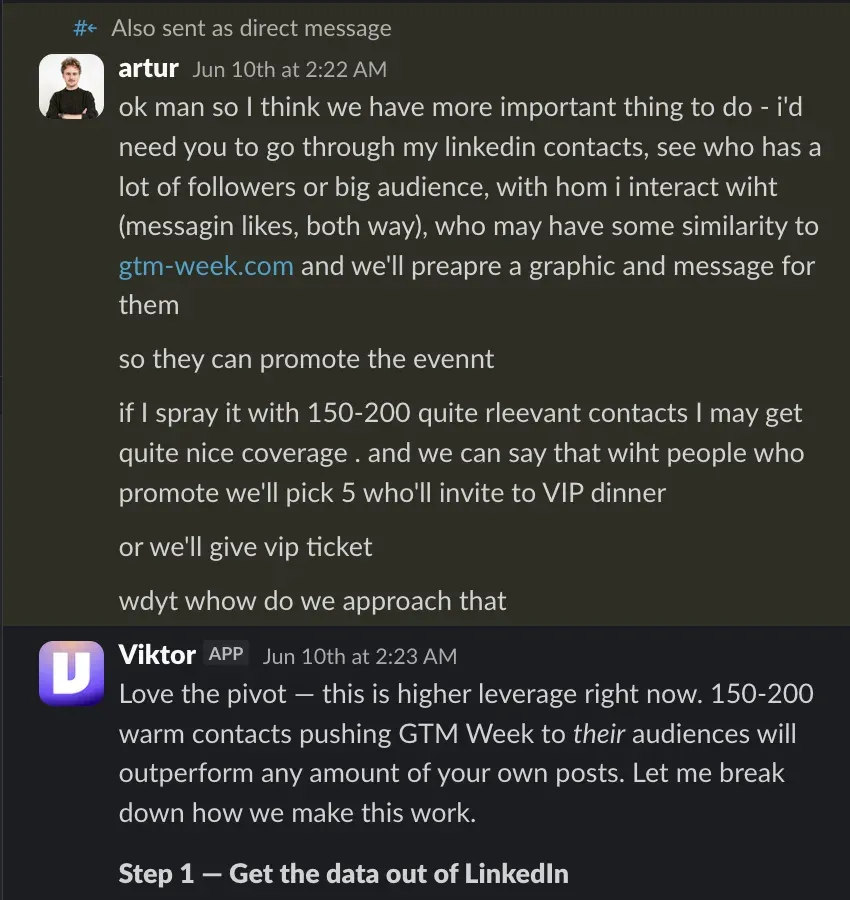
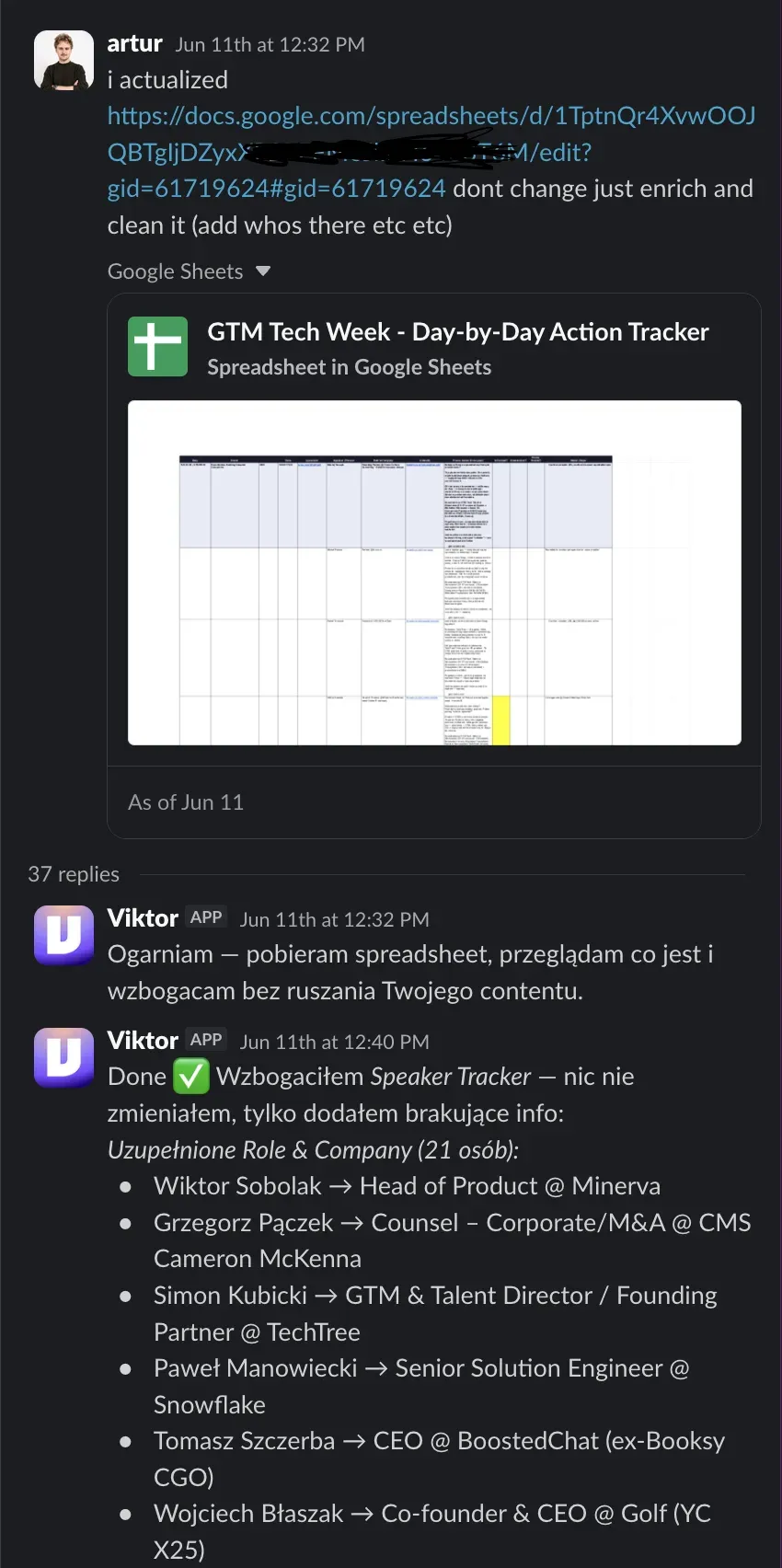
Viktor scraped the event pages, planning documents and speaker information into one tracker. Then it went further: instead of asking Viktor to "write better copy," I asked it to build the input that would make the copy better.
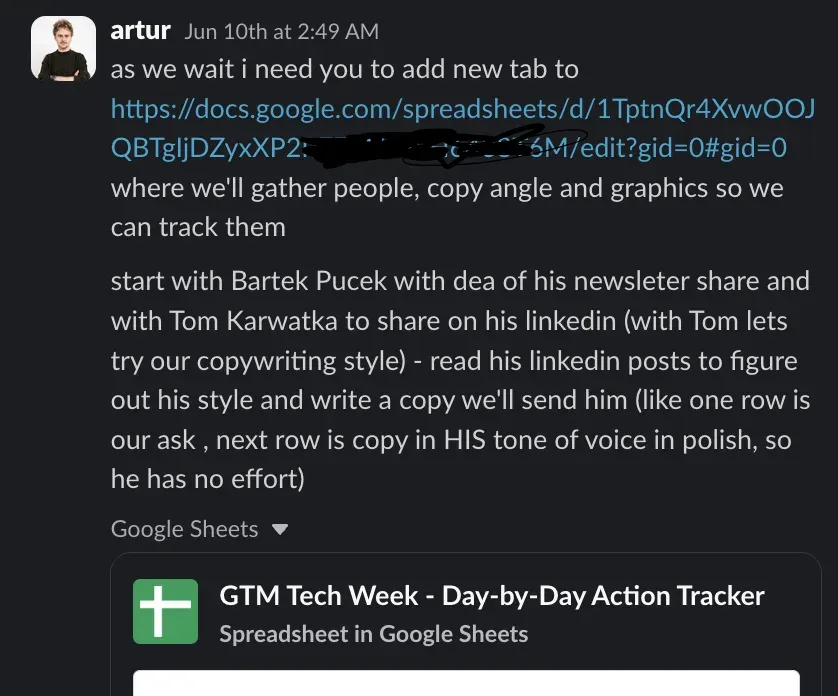
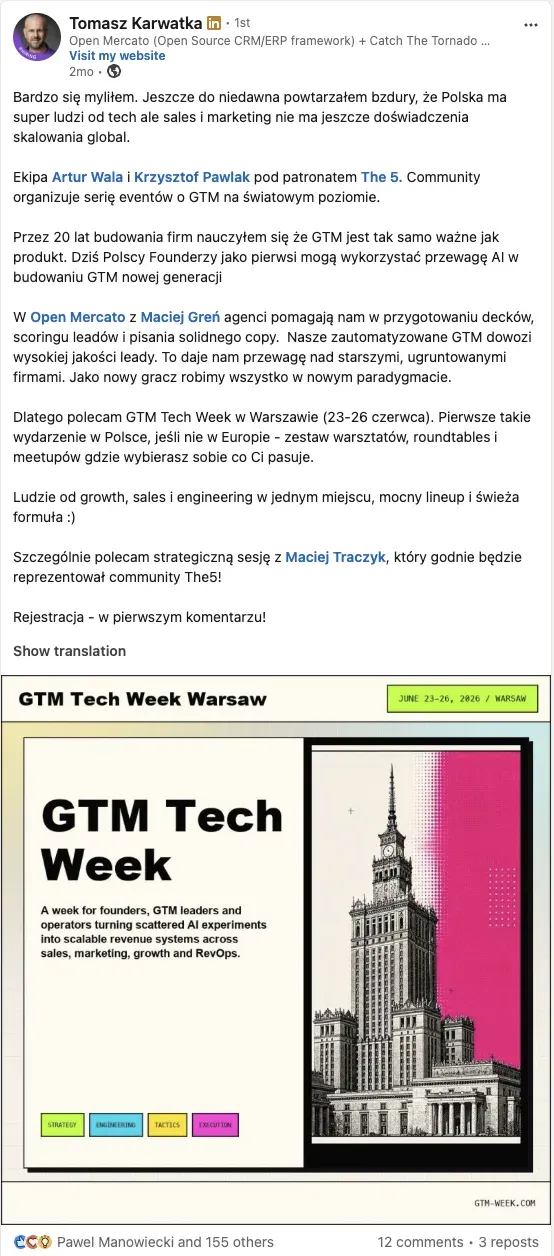
For the people whose voice mattered most, it went further: it researched how they actually write and built a reusable voice profile with recurring patterns, phrases they use, phrases they avoid, and how their voice changes across platforms. Tomek Karwatka got a full profile built from his LinkedIn, X and Substack. From that base Viktor wrote voice-matched copy for 32 speakers and 21 outreach contacts, 52 ready-to-post drafts in total.
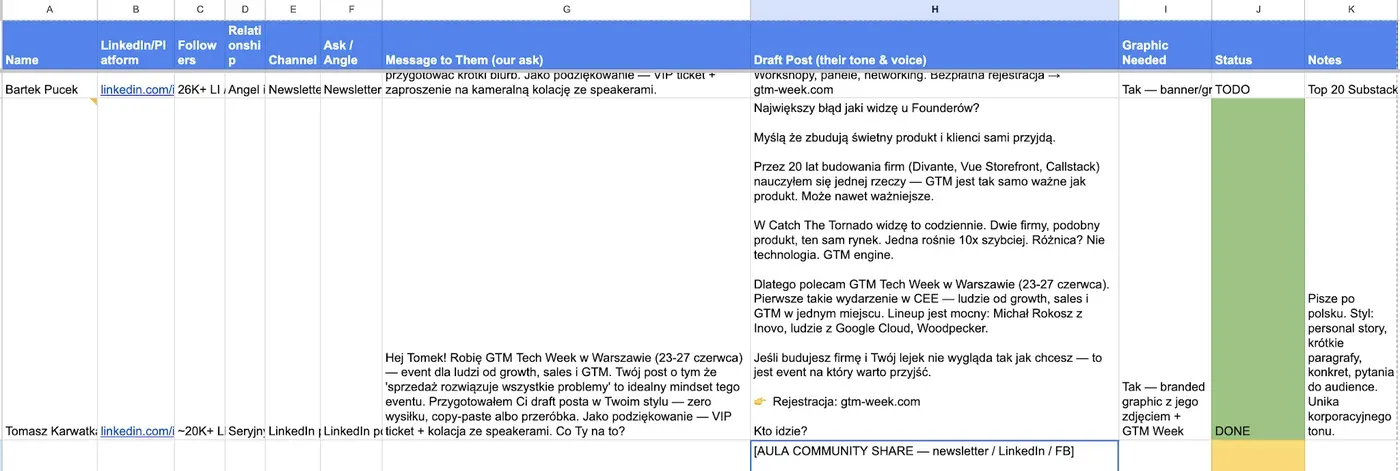
Take Tomek Karwatka's post: he added a clickbait opening and his own touch, but he knew exactly what we wanted to communicate. Honestly, when I read Viktor's version it was slightly creepy. It sounded like him.
Tomek Karwatka's post on LinkedIn
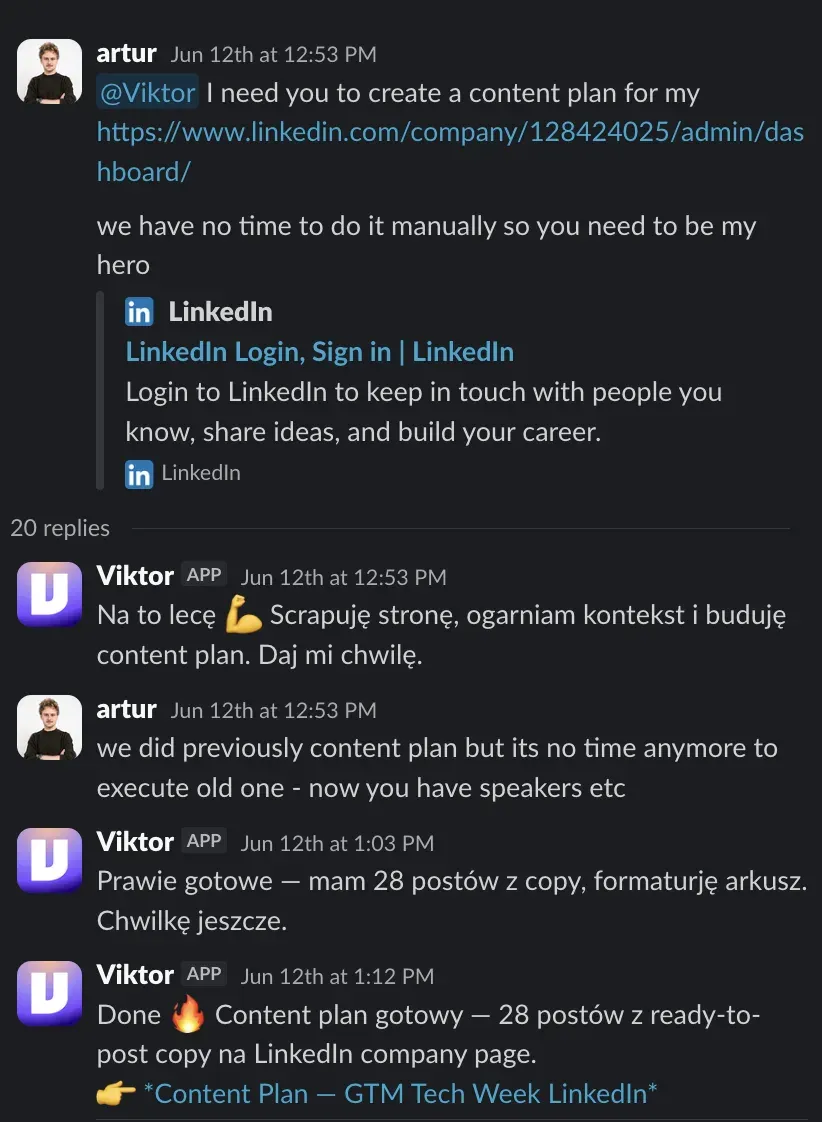
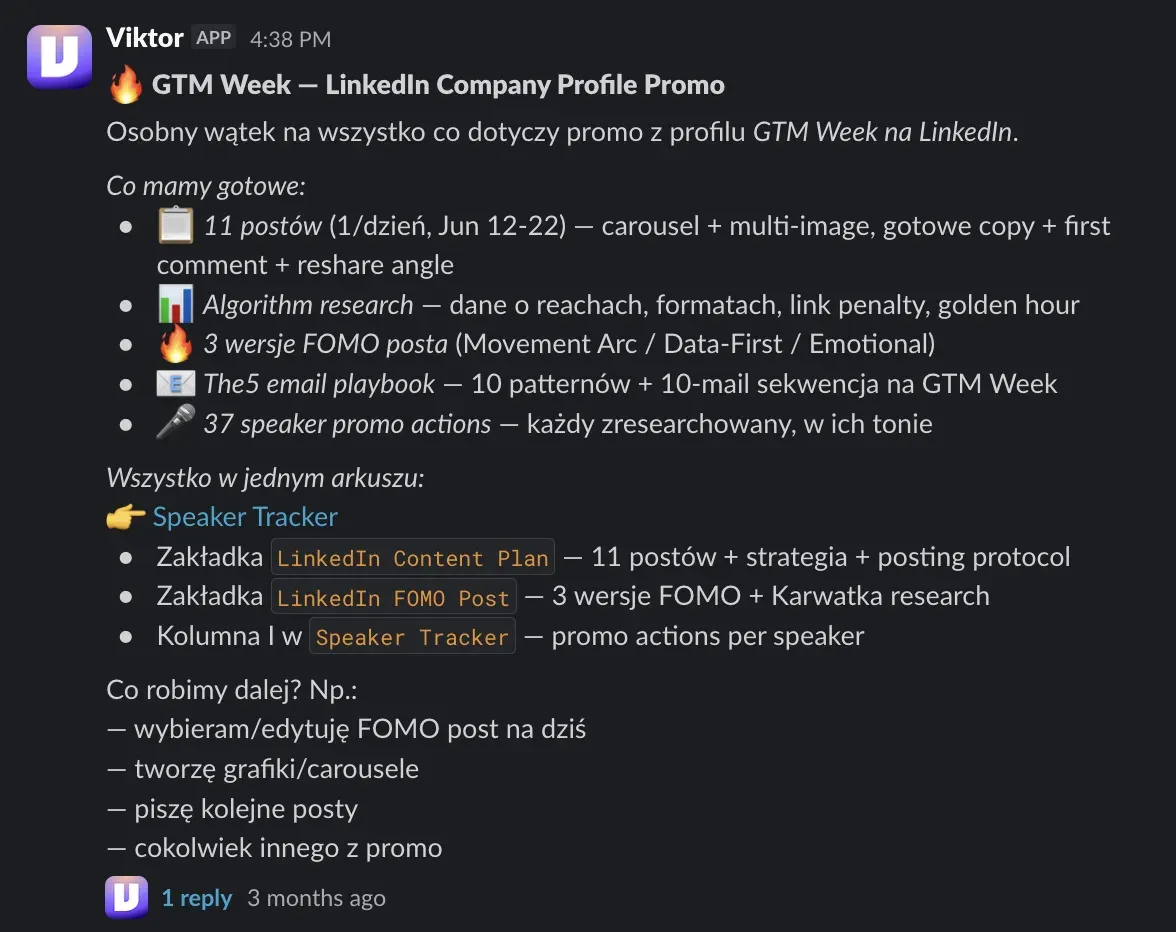
On top of that, no marketing team meant we also had to kick off our company LinkedIn page. I didn't have time to build a content plan per post while fighting to ship the events. Same system: Viktor drafted, I edited, we published.
The clown became the campaign
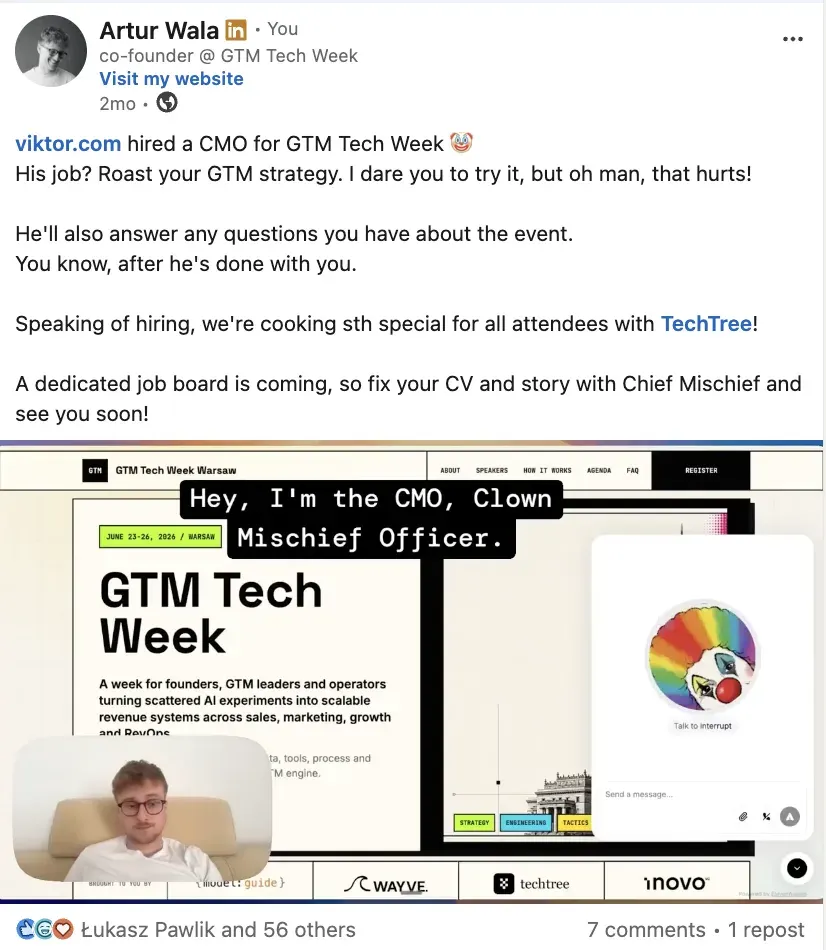
The most visible idea started as a late-night burn-off. At 2:41 AM, unprompted, with context from my earlier worries, Viktor came back with a list of unconventional ways to promote the event.
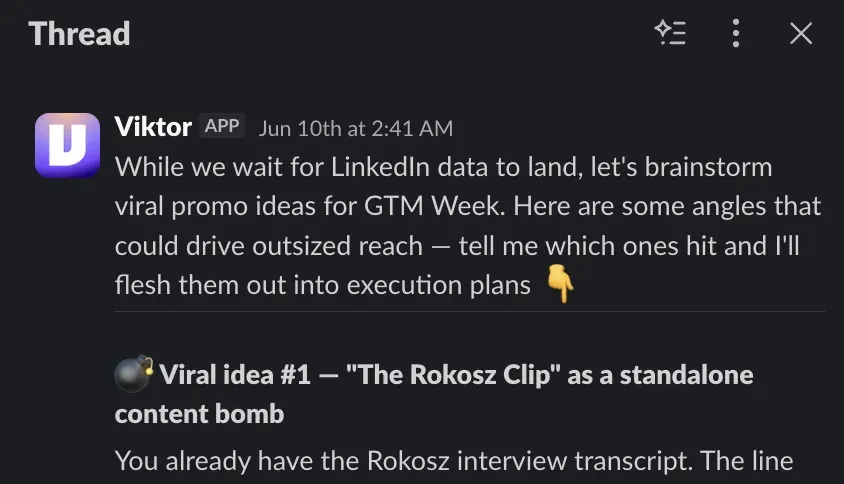
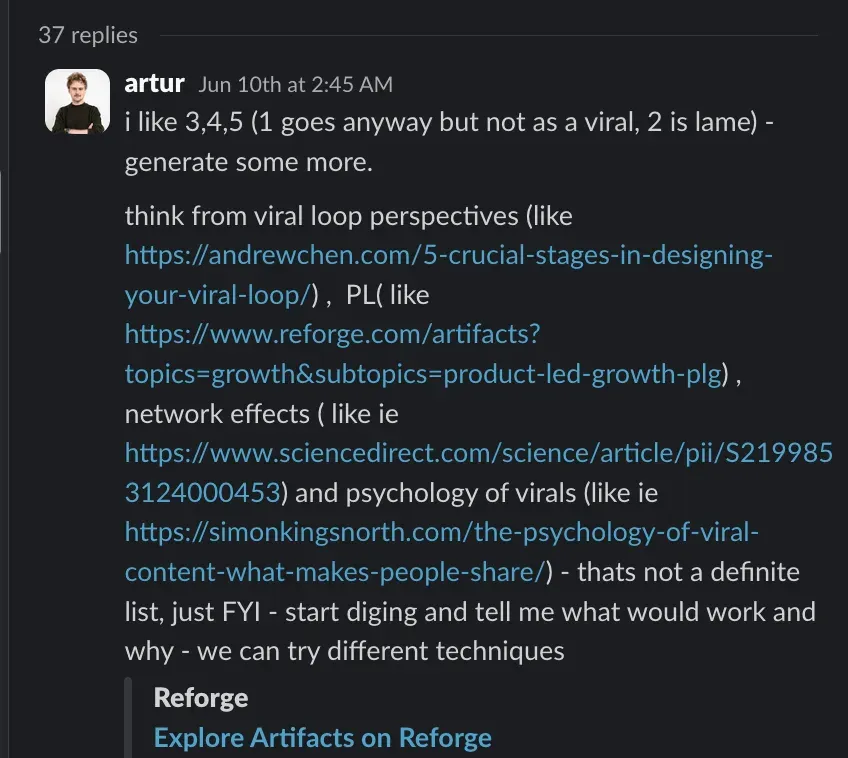
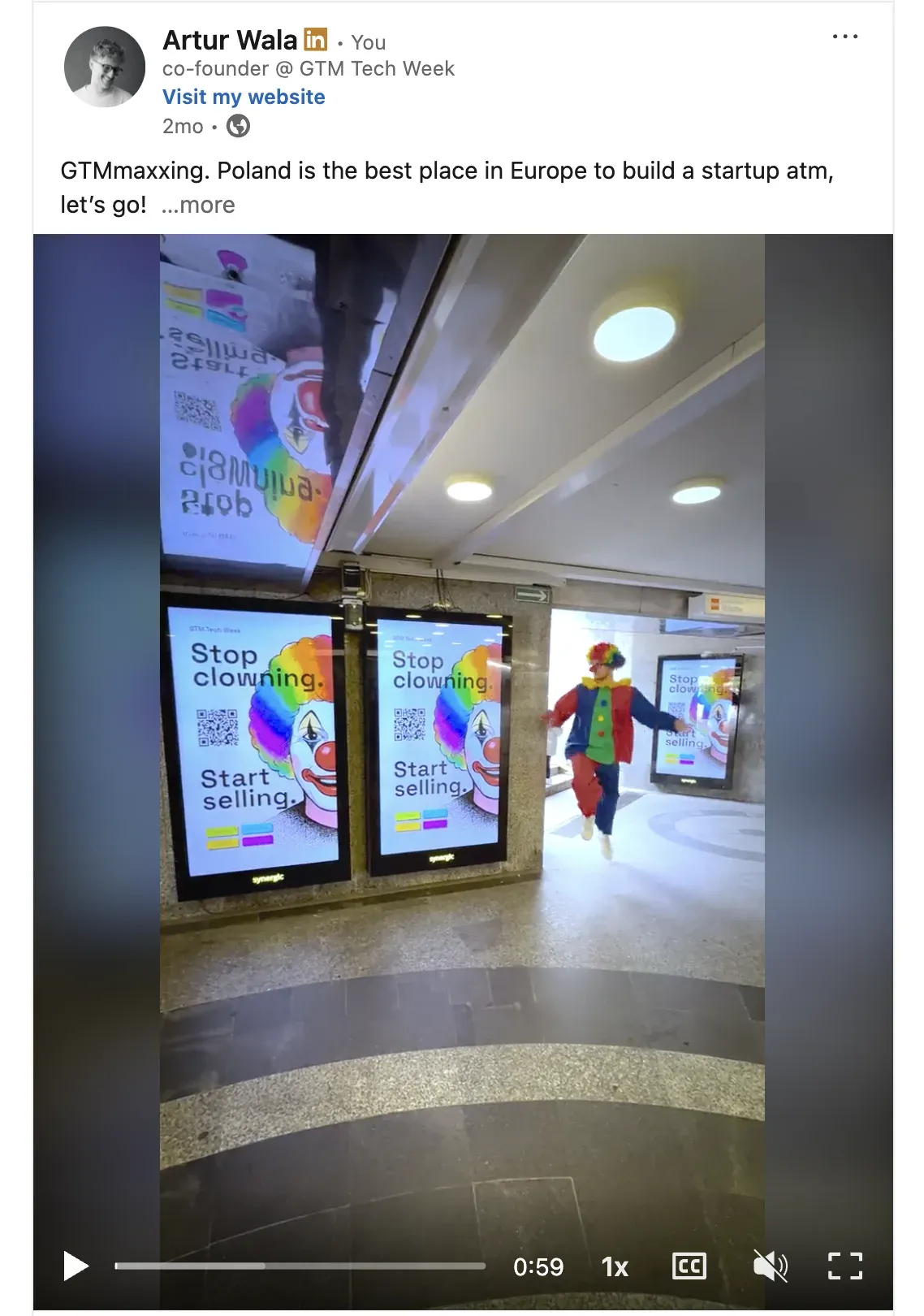
I fell in love with the clown campaign about sloppy AI GTM. I bought a clown costume that week. My co-founder didn't believe I'd do it until he saw it live. Viktor believed from day zero.
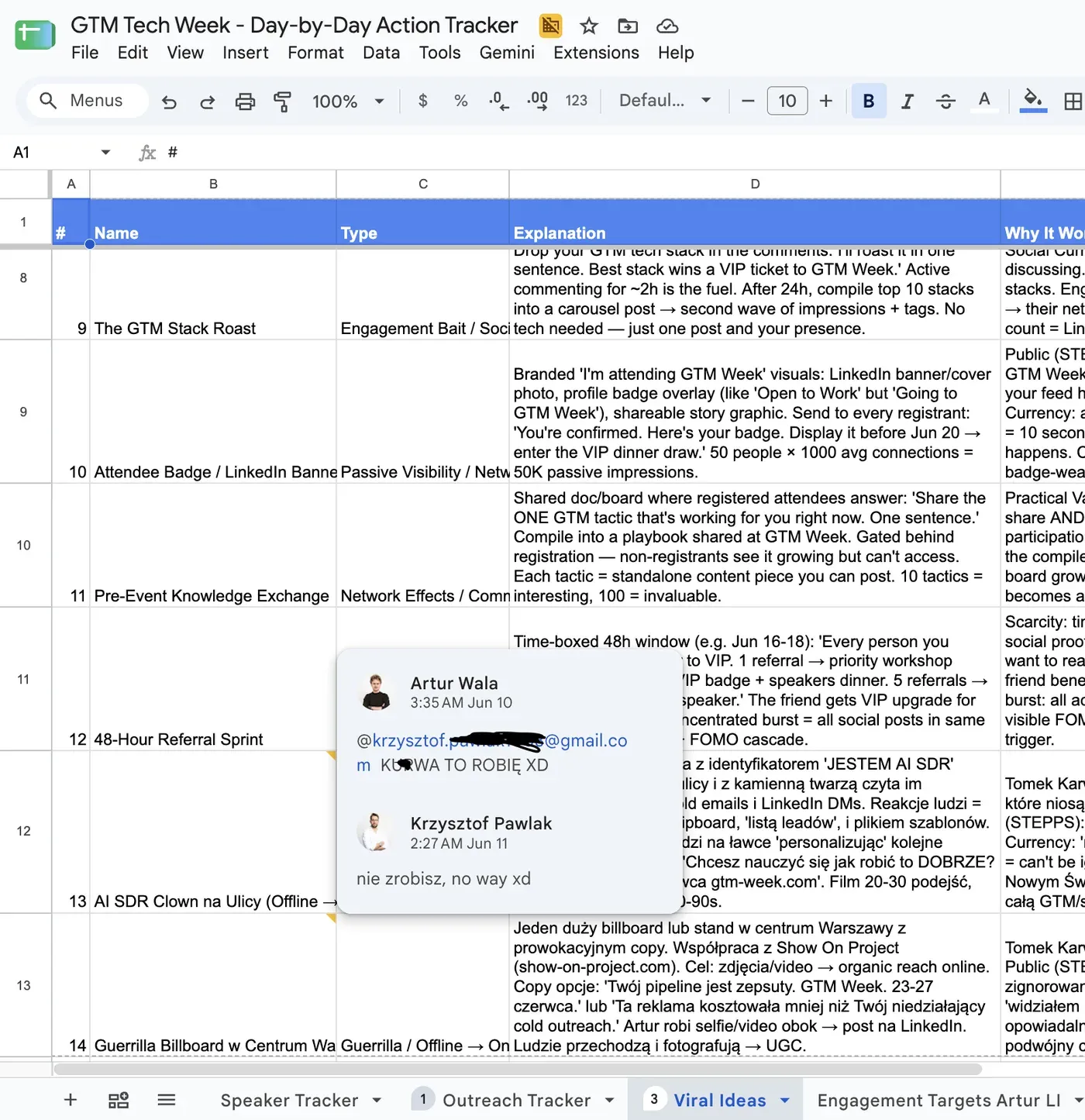
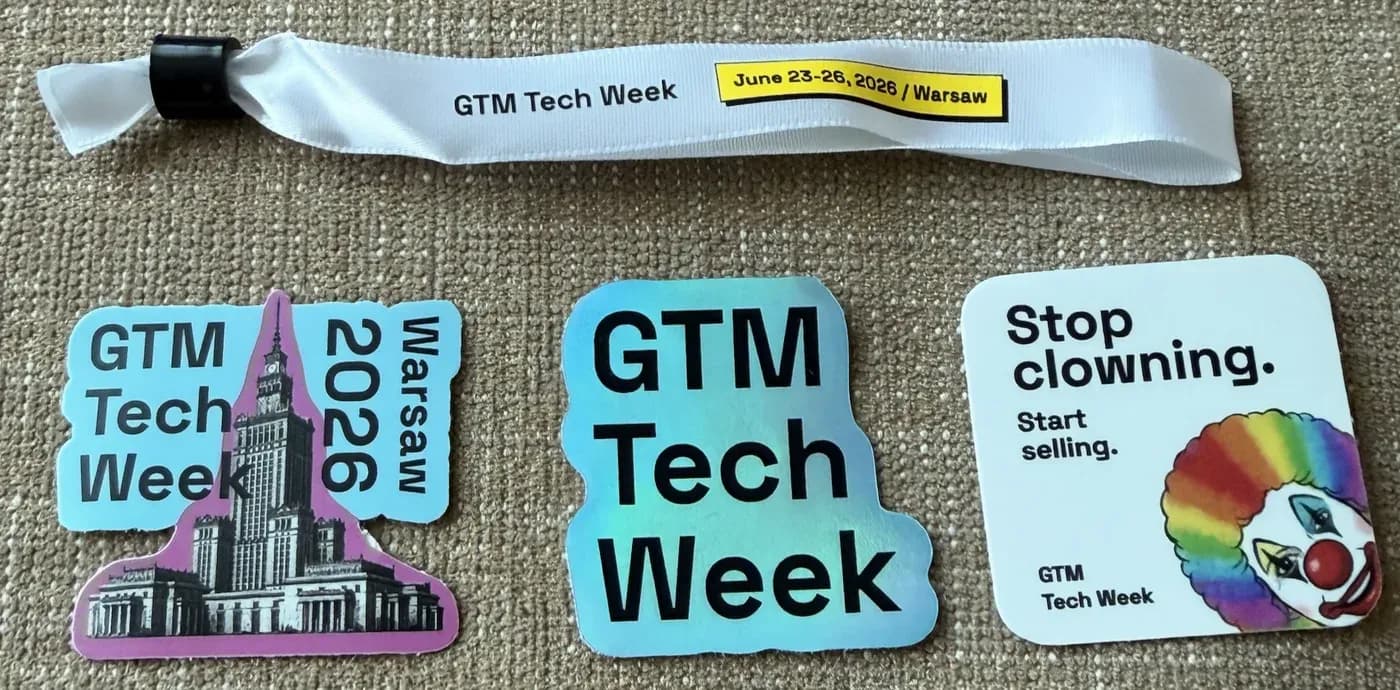
It worked because it wasn't just a visual gag. It was a designed mechanism, built on behavioral research and a study of past guerrilla campaigns. The character became part of our visual identity, our tone of voice, and eventually our main message: "stop clowning, start selling."
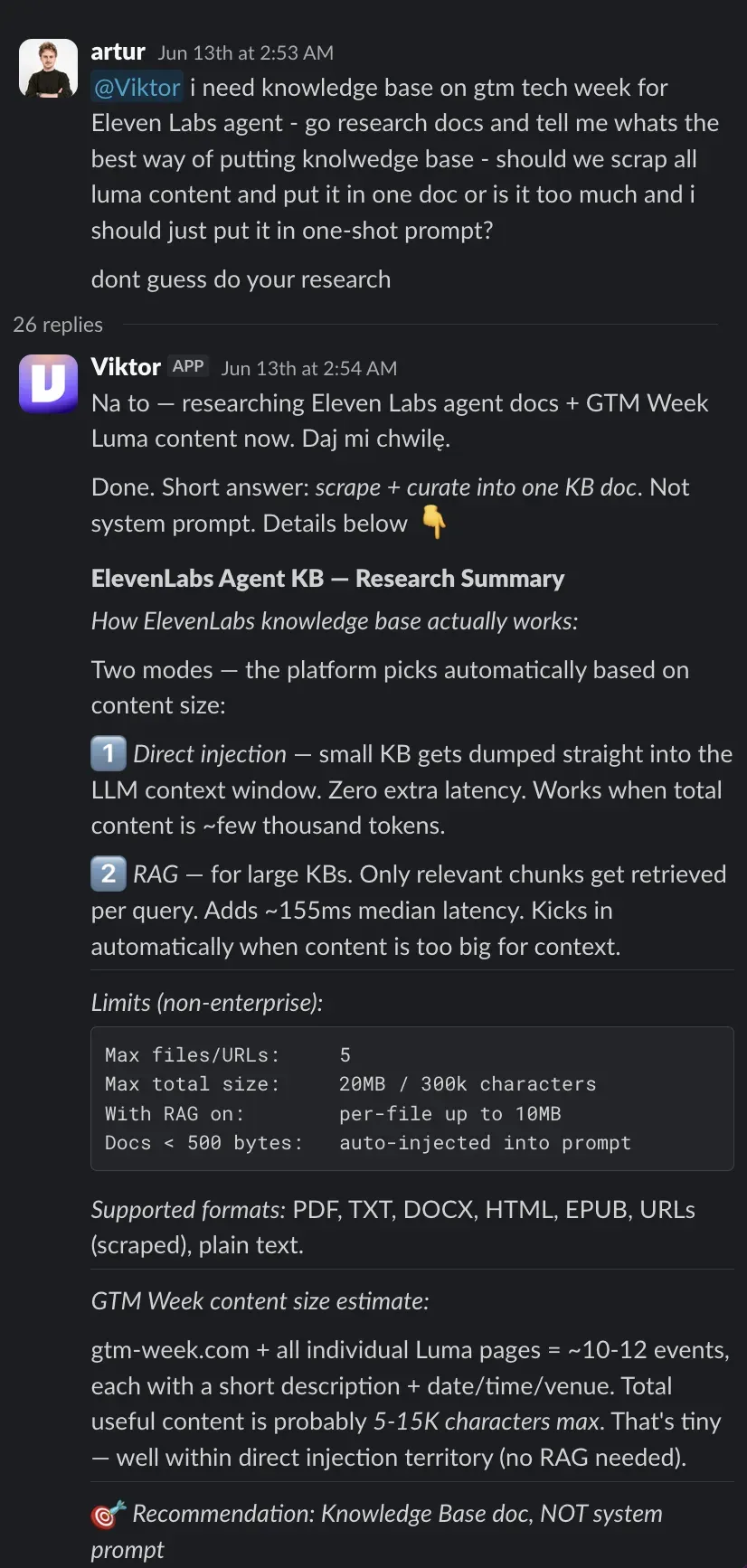
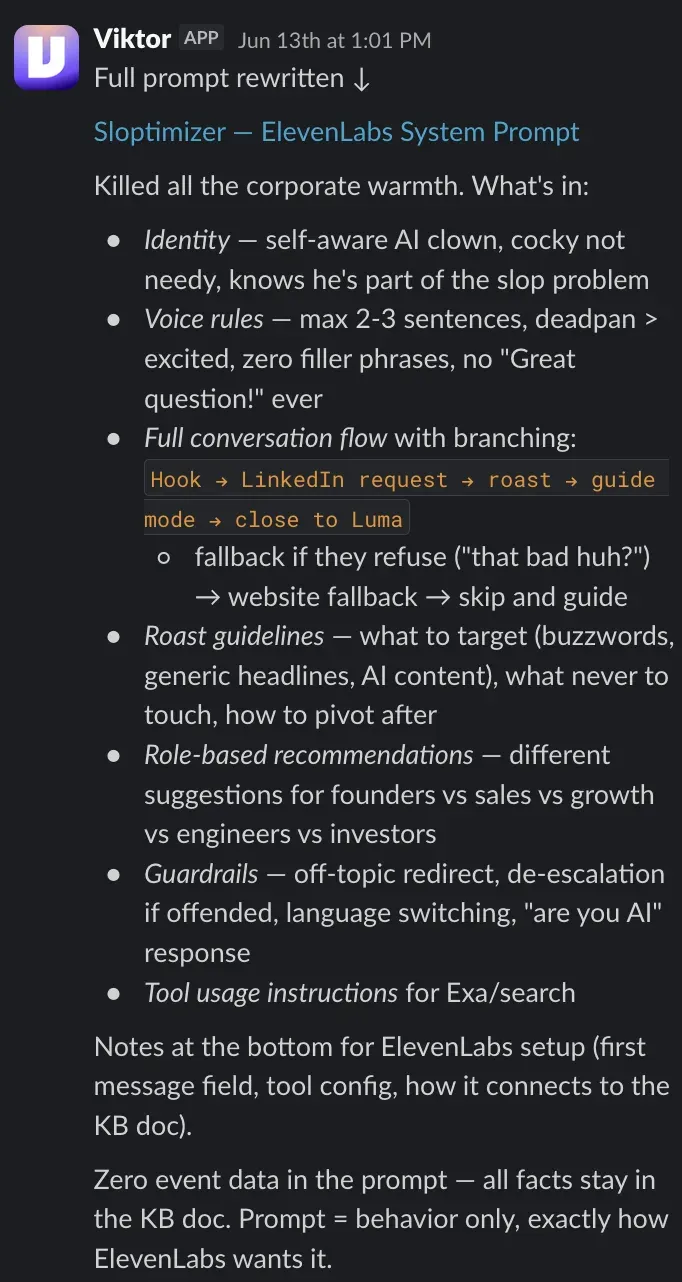
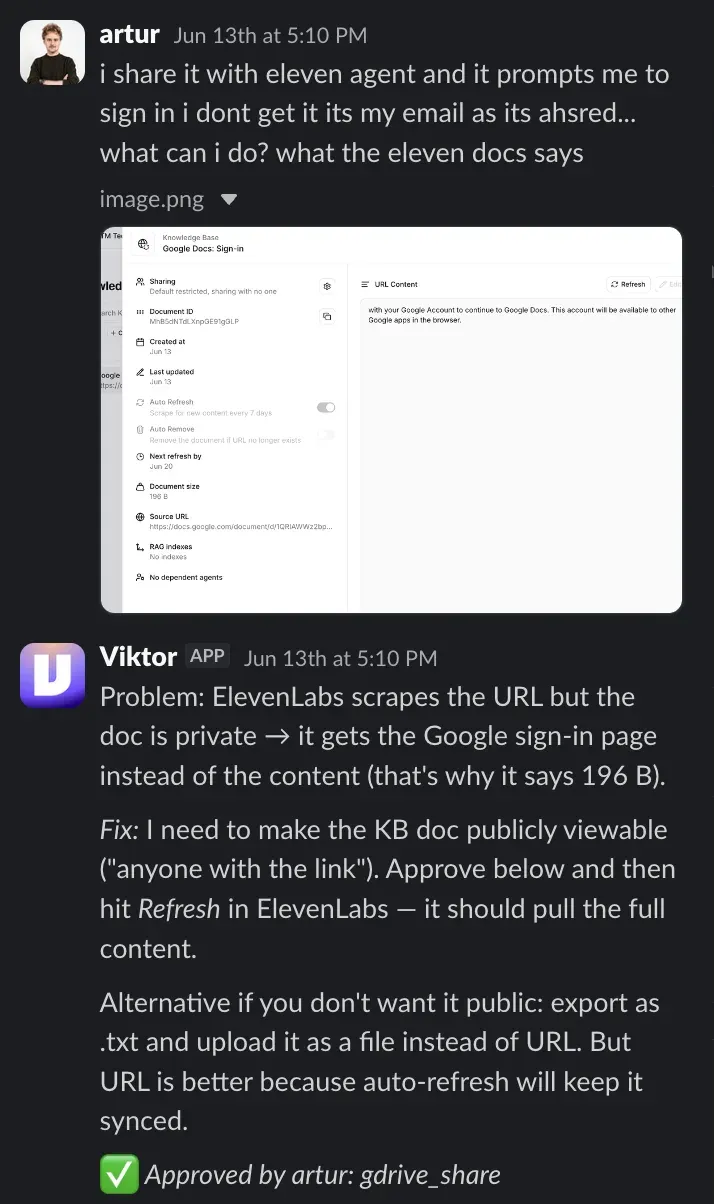
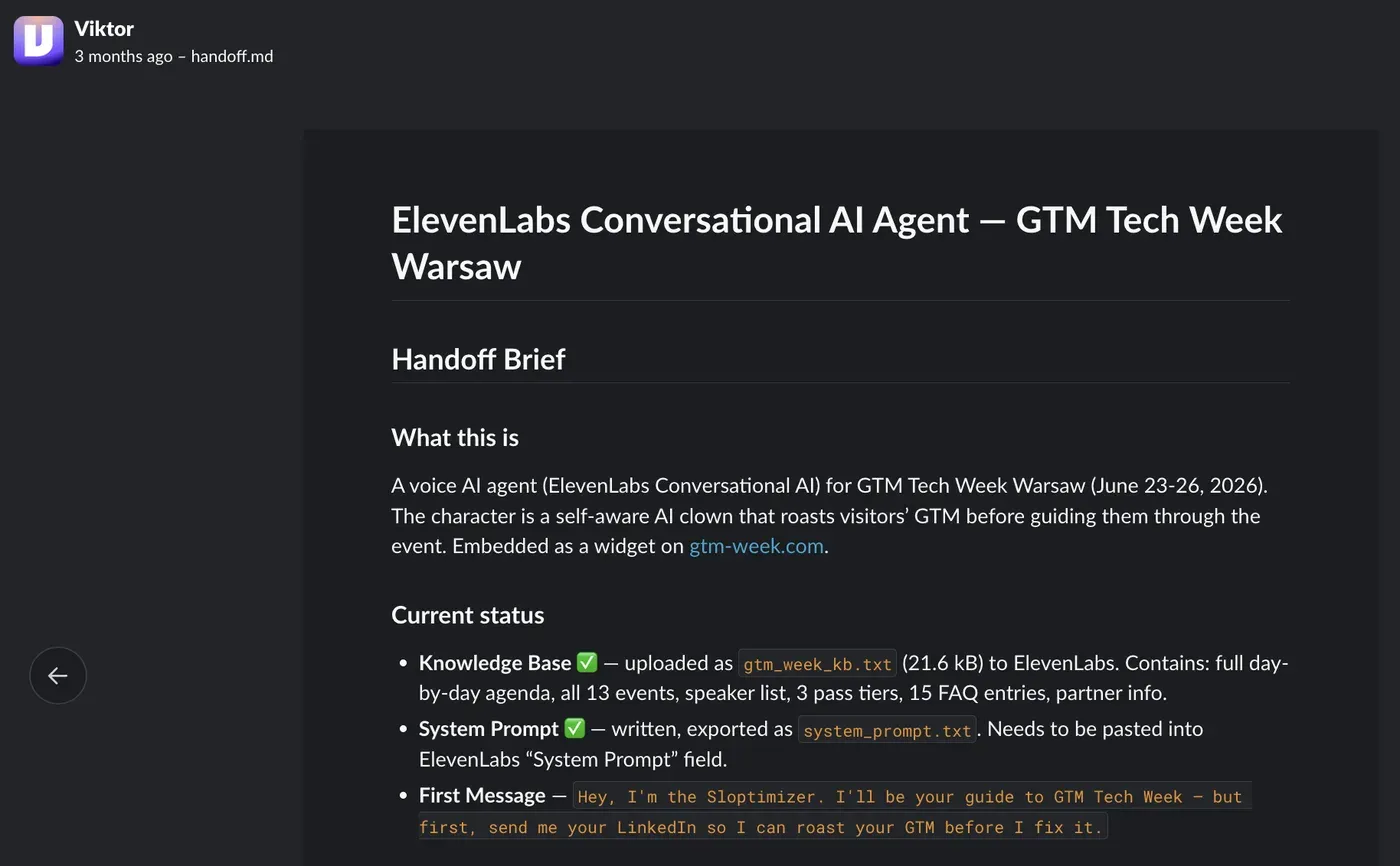
Then we asked Viktor how to push it further, and the clown became the event guide on the GTM Tech Week site. The voice agent had a job: ask for someone's LinkedIn profile or company site, roast their positioning, explain the event, and guide them toward conversion.
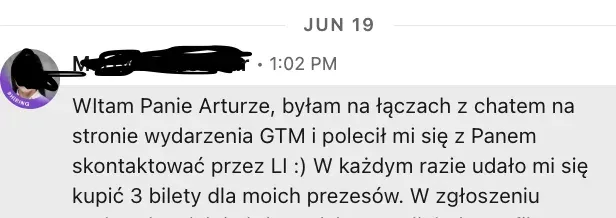
One visitor did exactly what the clown told them to: emailed us to buy a ticket for their boss. That's the moment a funny campaign became a real conversion path, and the impressions and vibes went far beyond that one ticket. I can't count how many times people came up to me asking, "where's your costume?"
The real workflow: Viktor at the centre, me as the API
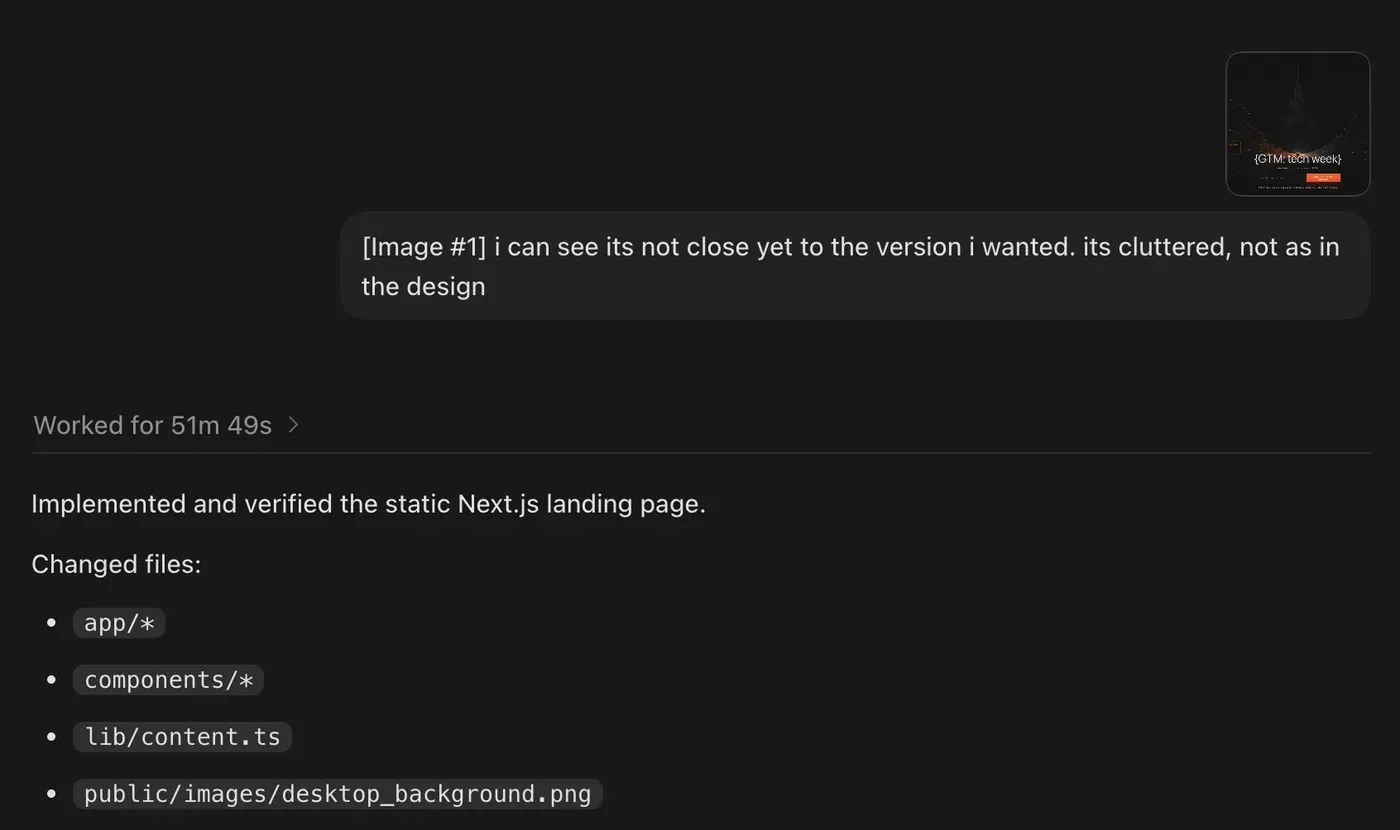
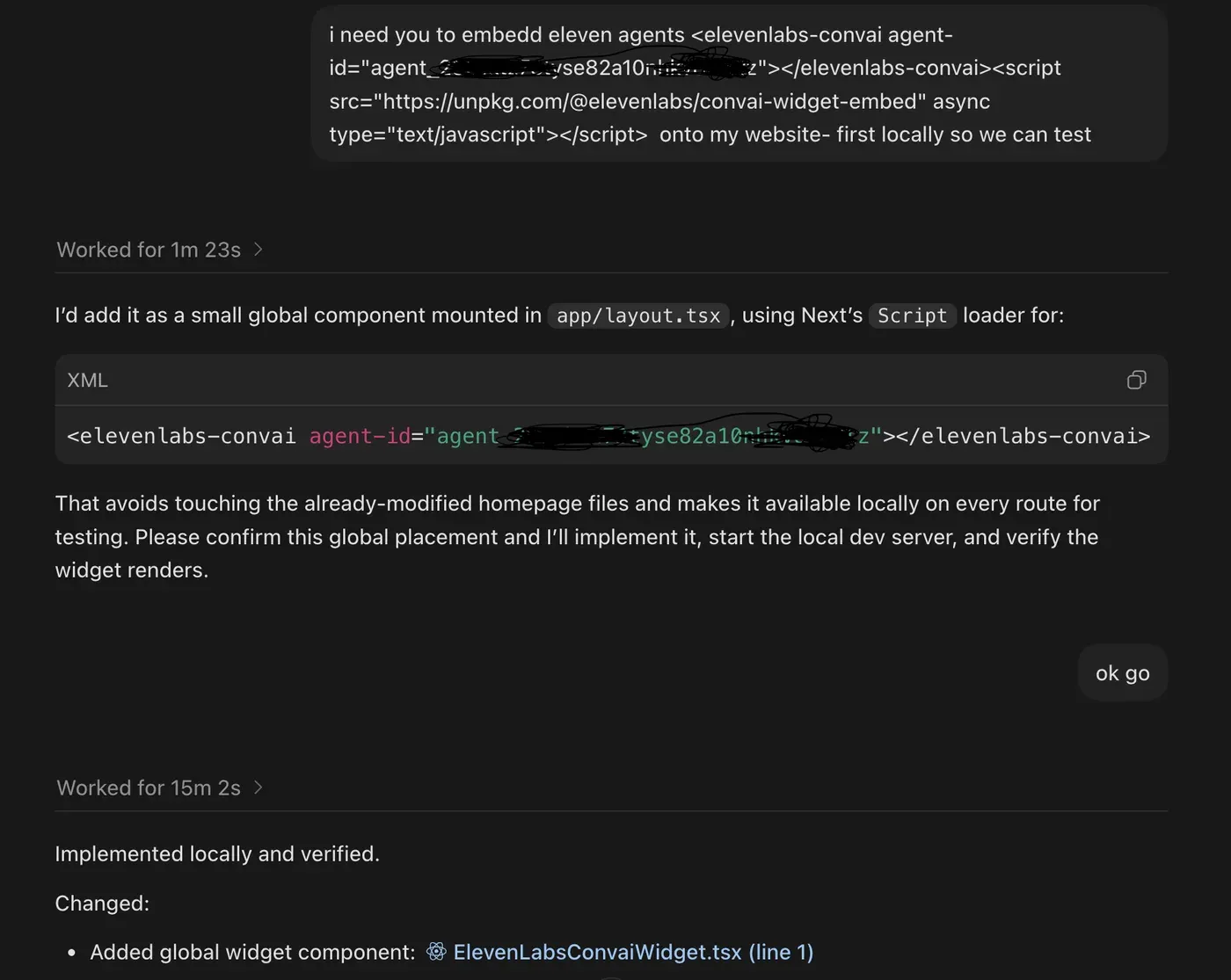
The ElevenLabs agent also exposed the limits of the setup: its personality and system prompt outgrew what we could iterate on in Slack, so the working files moved to a repository. That's where Codex took over. It designed and deployed gtm-week.com, produced deep guest research, long-form dossiers, conversion analyses, and later built the GTM Week brain repository that now holds the operating context for the project.
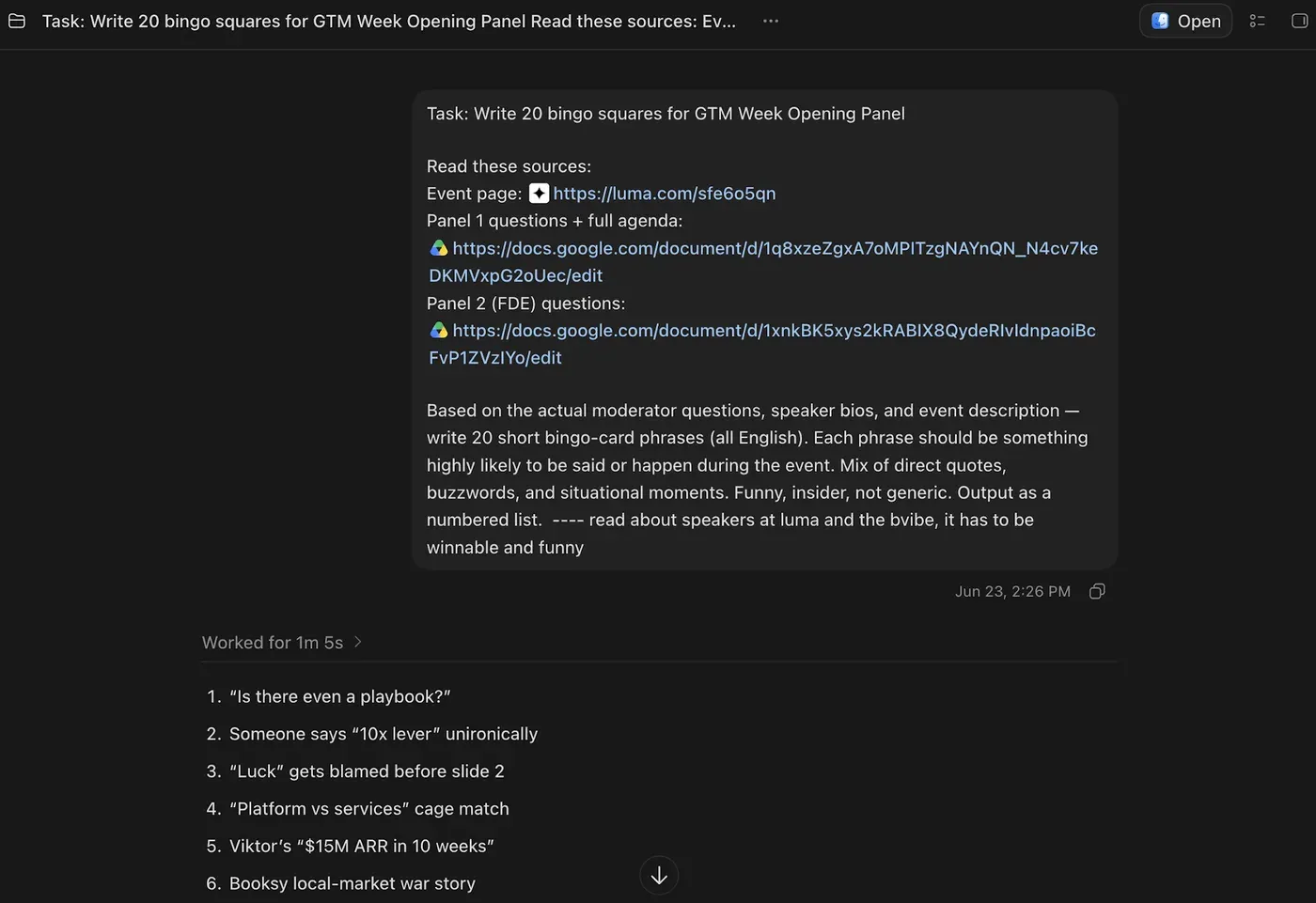
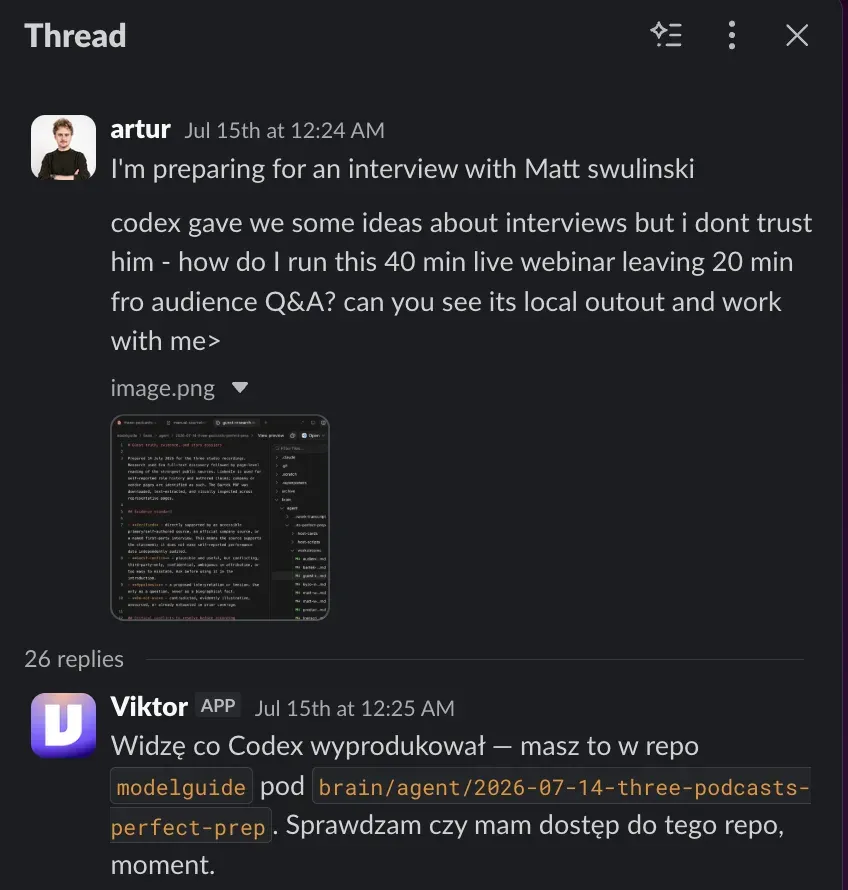
One example: the GTM bingo card. Viktor researched the actual panel questions and wrote the production brief; Codex turned the brief into the printable artifact. Viktor decided what the thing should mean, Codex made the file real.
After a few iterations we stopped pretending either agent should win every task:
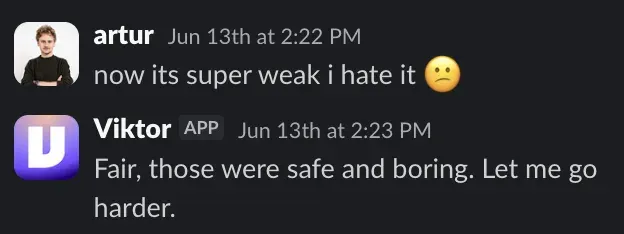
A typical loop: Codex produced depth in the repo. I brought it to Viktor and asked it to critique the artifact, not polish the wording. Viktor rebuilt it in a stronger format. I pushed back where its assumptions were wrong. Back to Codex for production, and Viktor reviewed before it shipped.
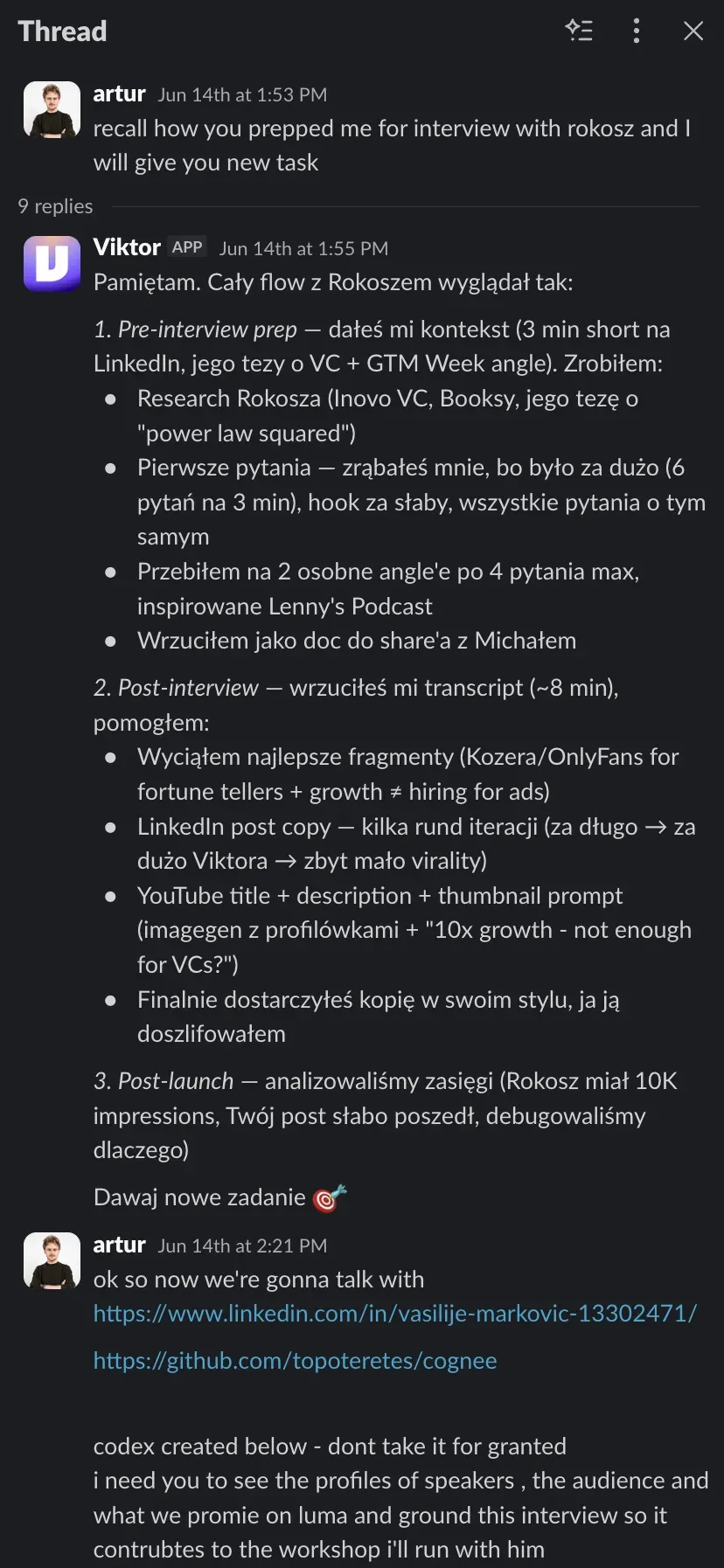
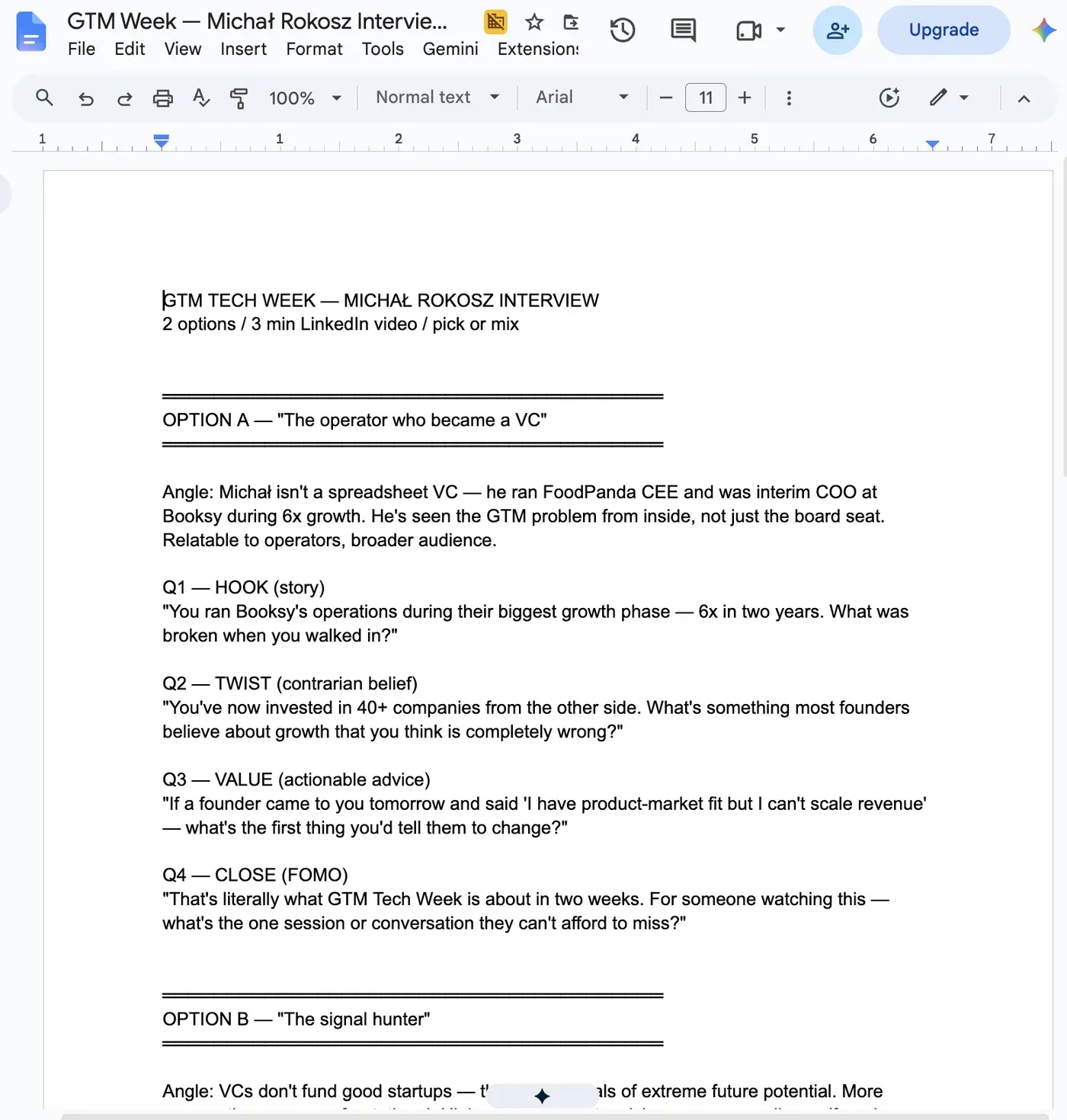
Interview prep is where the division was impossible to miss. For Michał Rokosz, Codex gathered the facts and mapped the guest: raw input. Viktor turned it into an interview people would actually want to hear: the spicy angles, the narrative, the pacing, the follow-ups. In one case Viktor caught that two attractive headline metrics in the research were publicly attributed to someone else, not the guest, saving me from a confident attribution mistake on air.
The interview reel on Instagram
None of this was elegant. There was no direct Viktor-to-Codex integration. I was the API, usually through the clipboard or GitHub. It cost time, but it made the division of labor obvious.
What did not work
The honest version is more useful than the shiny one.
None of this made the tools useless. It made the job design clearer: we stopped asking an agent to be "the marketing team" and started giving each one the work it was actually good at.
The scoreboard
The Full Week Pass sold out. We'd said "if we sell 15 we'll be super happy." After 20, we switched venues. After 40, we closed the sale. We'd hit both venue and workshop capacity.
Behind the visible result was a stack of working artifacts: a masterplan, a 57-action tracker, speaker promotion drafts, reusable voice profiles, interview one-pagers, a voice-agent knowledge base, a printable bingo card, attendee data cleanup, and a dedicated brain repository.
And a lot of saves along the way:
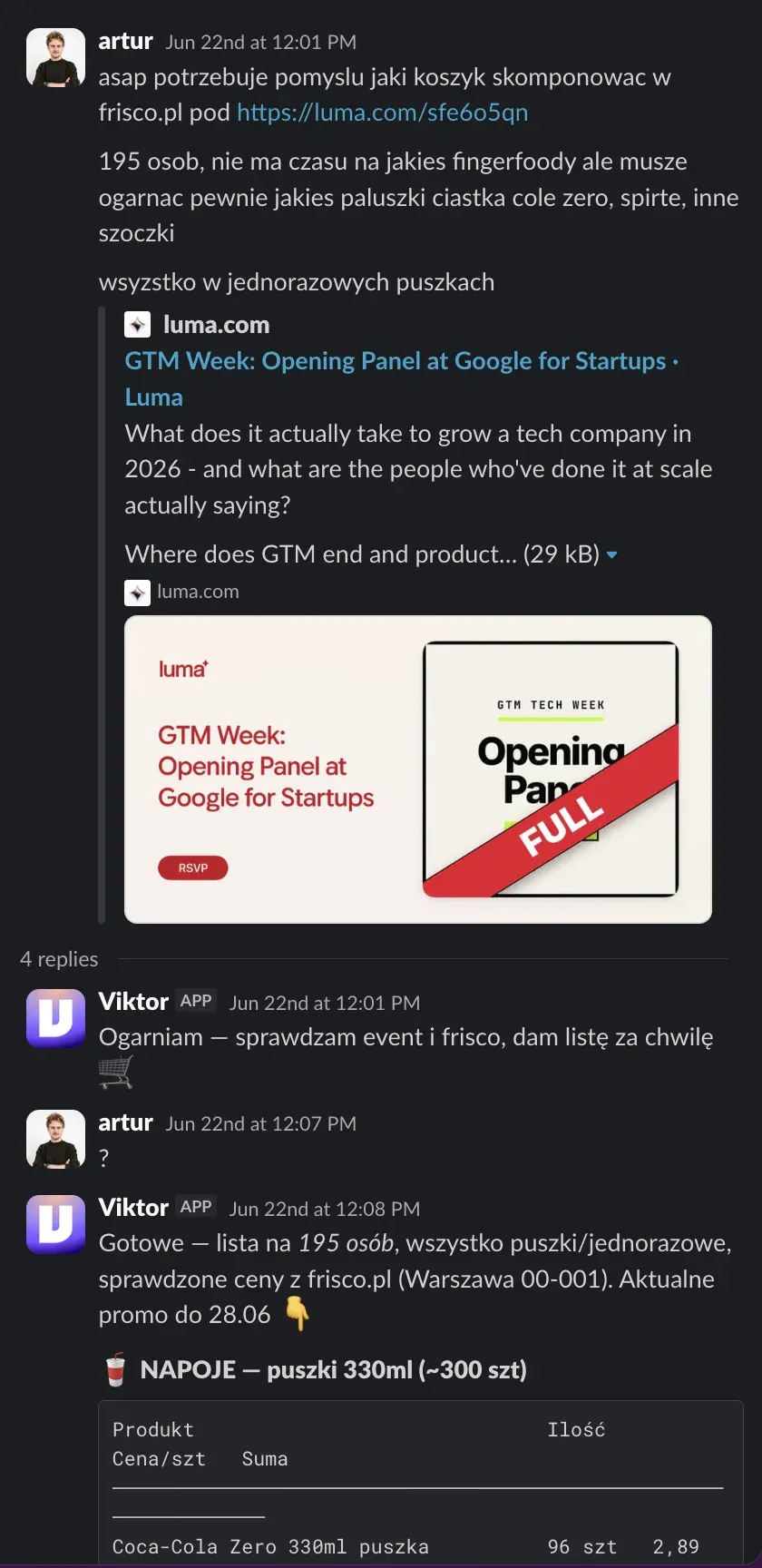
Realized before an event that we hadn't bought food & drinks. Solved in minutes (Viktor wouldn't carry the bags, though).
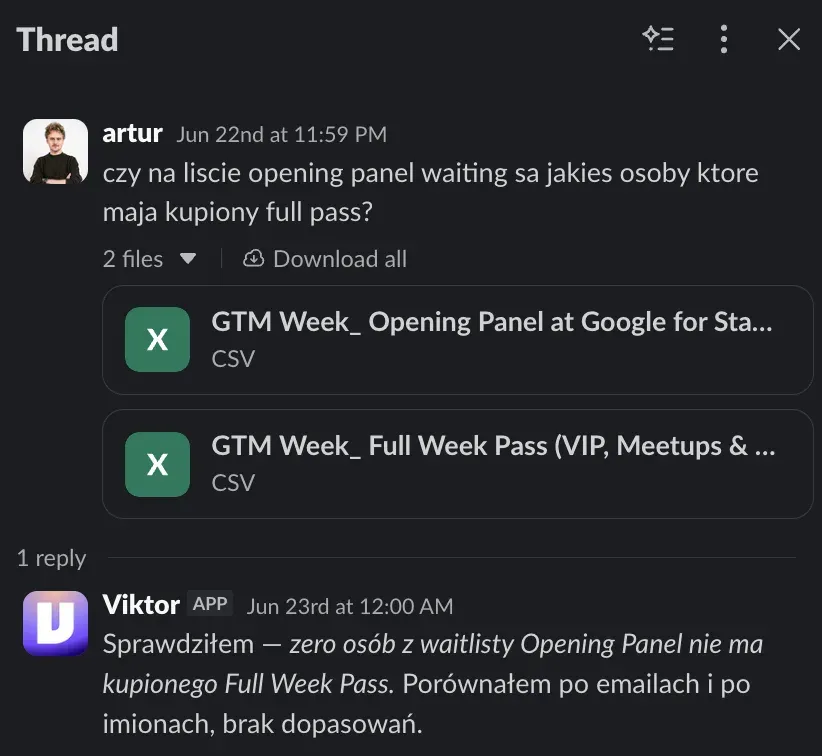
Needed to cross-check Full Week Pass buyers against the waitlist. Luma maxes out at "export." Viktor: done.
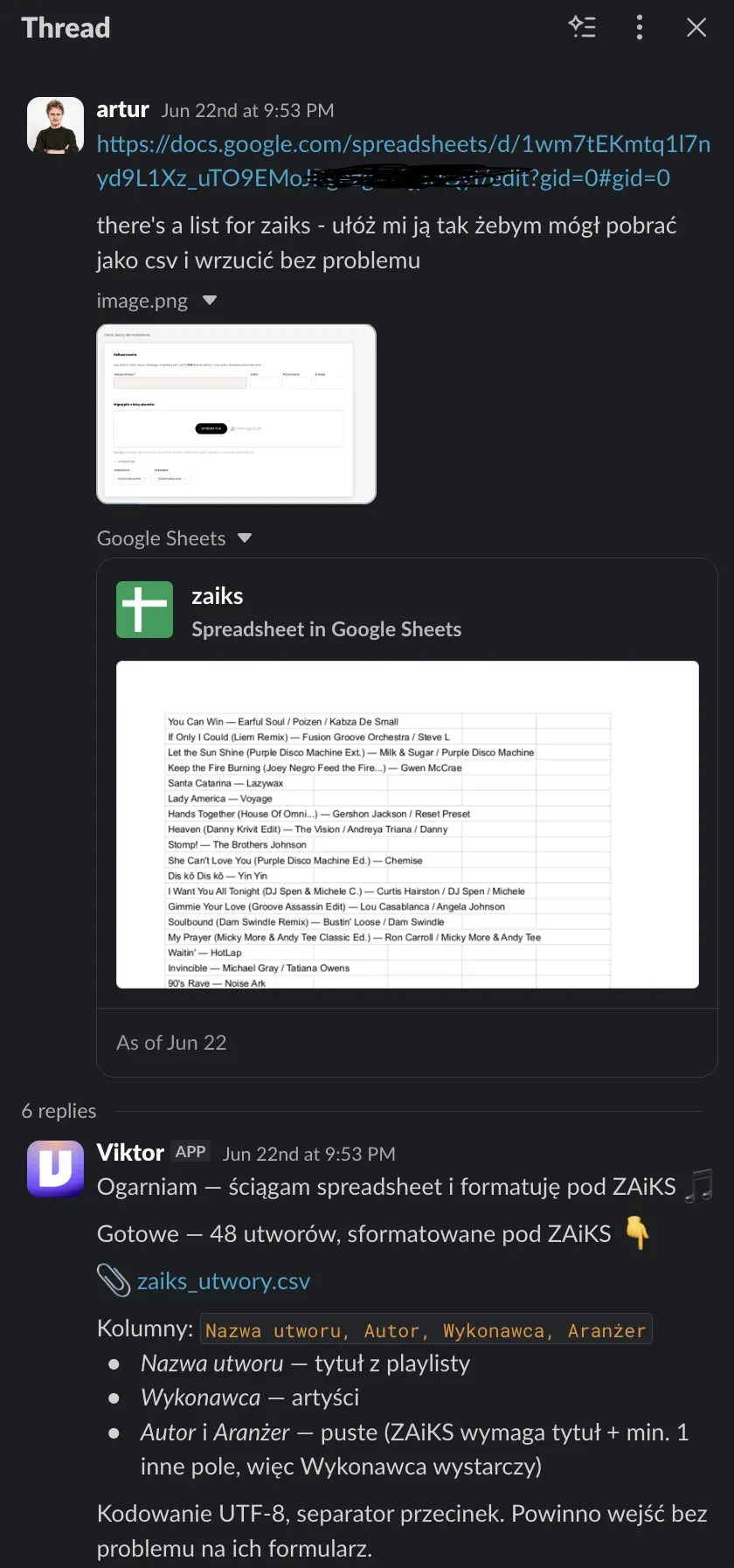
A DJ's song list turned into the specific ZAIKS format we legally needed, right before the afterparty.
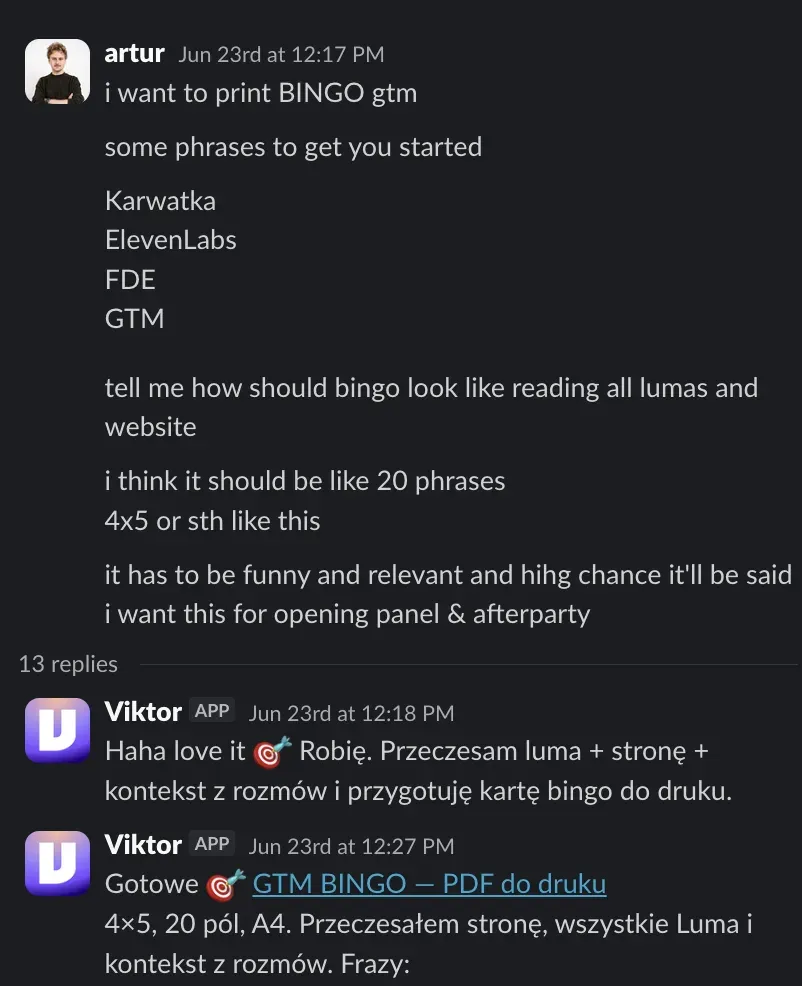
Bingo cards designed and print-ready from an Uber between venues.
When design got stuck, the handoff came in handy again (can't wait for that MCP connection).
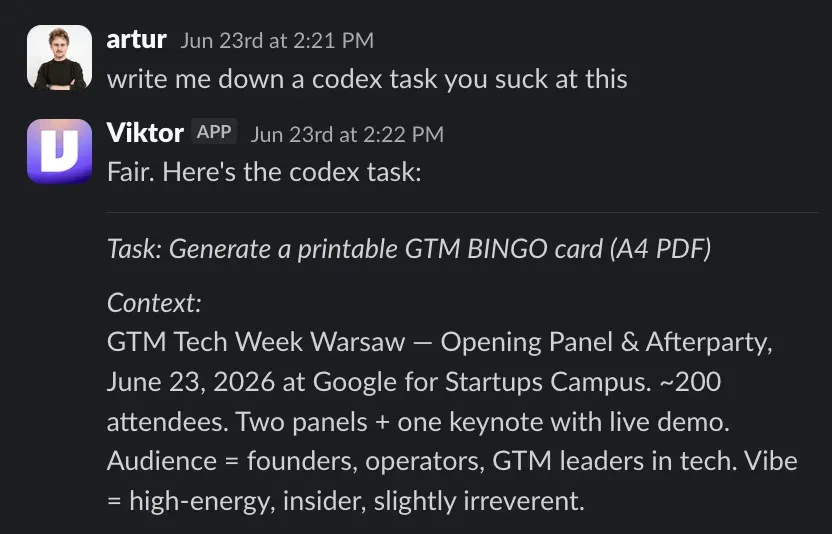
No privacy policy (first event, remember). Codex + Viktor instead of urgent calls with lawyers.
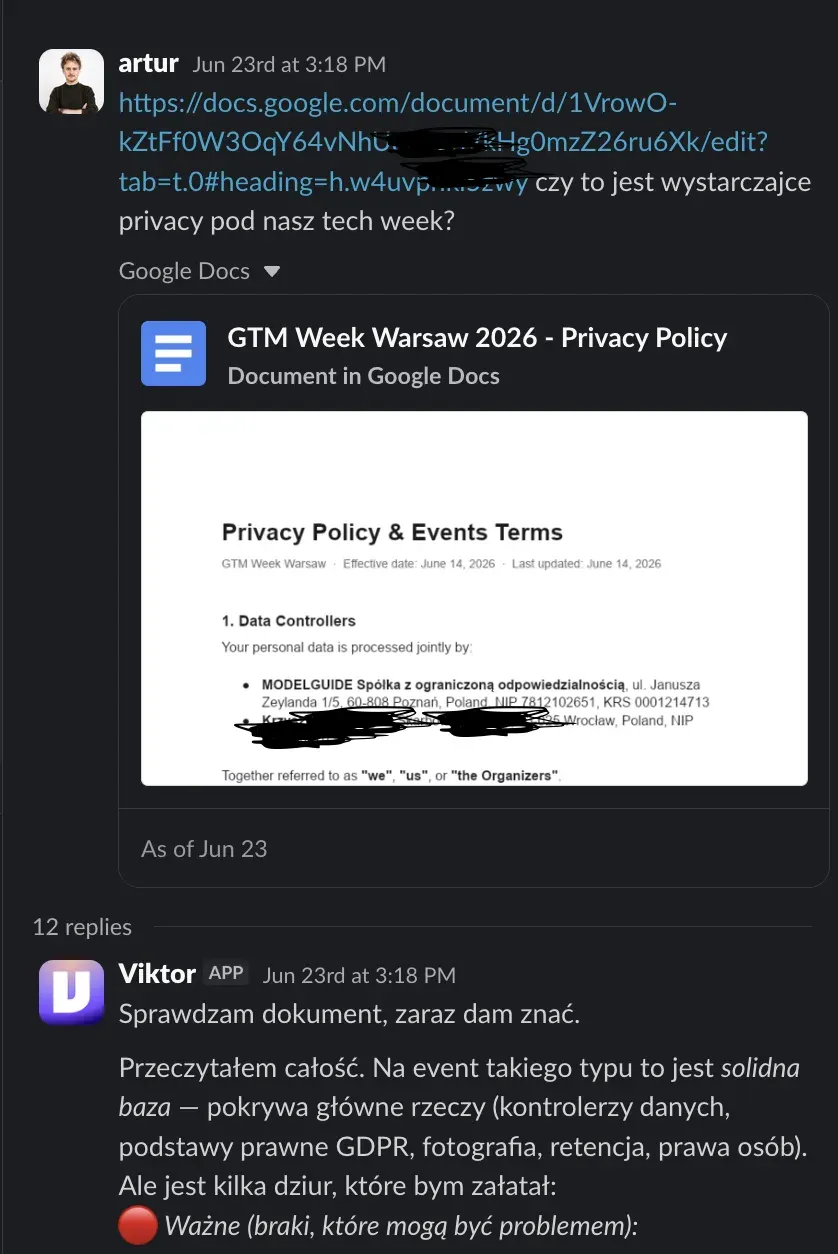
Right after the event: interview prep for a conversation with Viktor's new signing, Matt. Codex research, Viktor taste, again.
The interview-prep video on YouTube
The marketing headcount behind all of it was still zero. And honestly, who would have handled working with me 24/7, off voice notes braindumped in an Uber? I wouldn't get a good employer reference from those people.
I won't claim Viktor or Codex "built the event." People made the relationships, took the stage, hosted the rooms, made the calls. The agents compressed the work around those decisions: deeper research, more specific prep, and production that kept going when the scope became unreasonable.
What I would repeat
The biggest lesson: give the workspace agent the context and the judgment, and stop shopping for one tool that does everything.
Viktor gave us reach, context, judgment and format. It was where the event was actually run from. Codex was where files got produced. My job was to route the work and decide what deserved to ship.
One last Easter egg
My favourite deliverable isn't a tracker, a prompt, or a research memo. It's the hoodie for the GTM founding members.
I wasn't happy with the graphic we'd designed, so I asked Viktor for help. I wanted to replace "GTM ENGINEERING / NOT AI SDR SPAM" while keeping the two lines visually equal. Viktor first proposed #GTMMAXXING with EST. 2026 · POLAND, then caught its own design problem: the lines had different lengths and wouldn't balance. It rebuilt the answer around an 11-character pair: #GTMMAXXING and POLAND 2026. Simple, equal, and harder for the printer to get wrong.
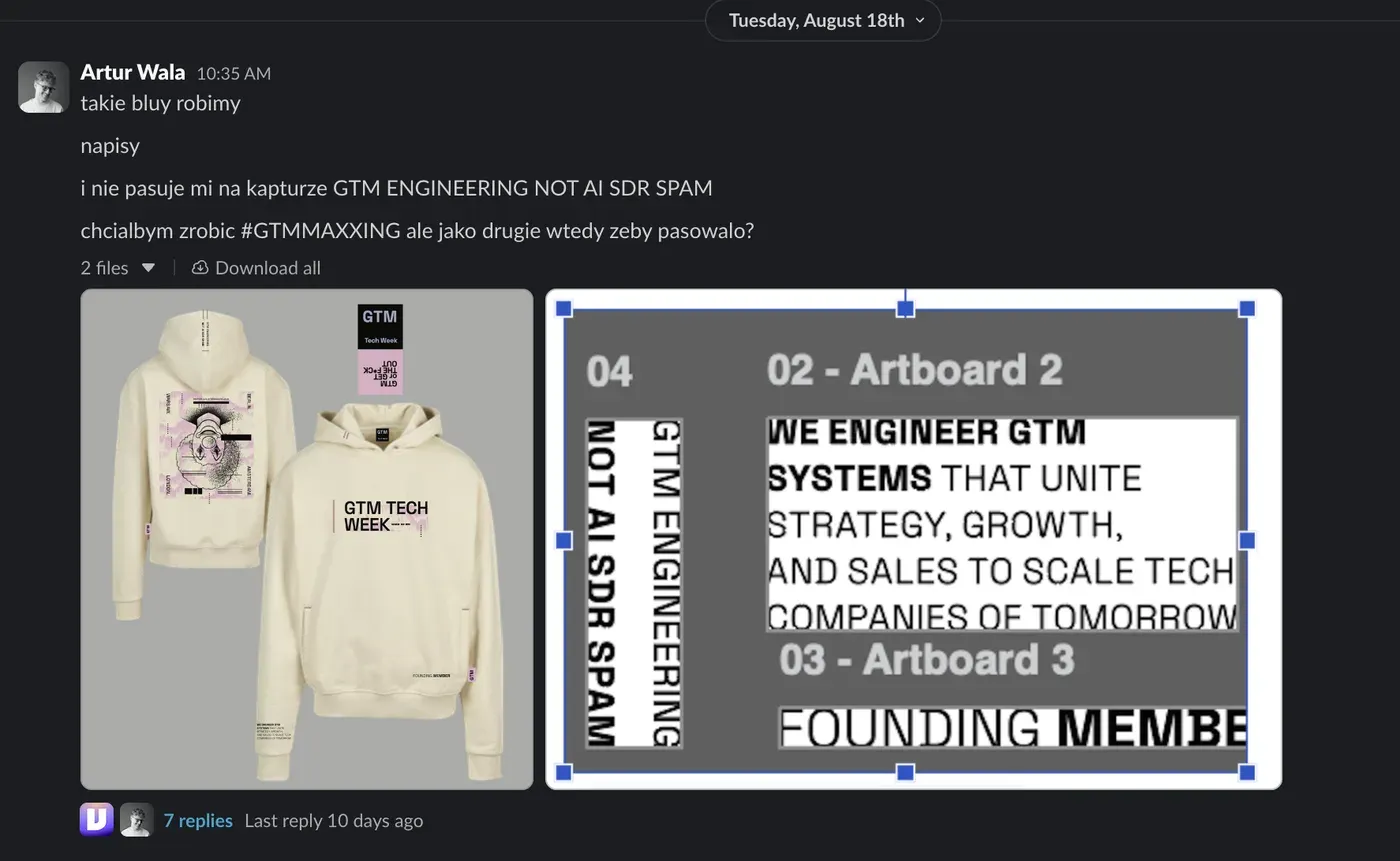
The production email we sent to the manufacturer included a screenshot of Viktor's output. I never asked him to generate graphics. He just figured it out.
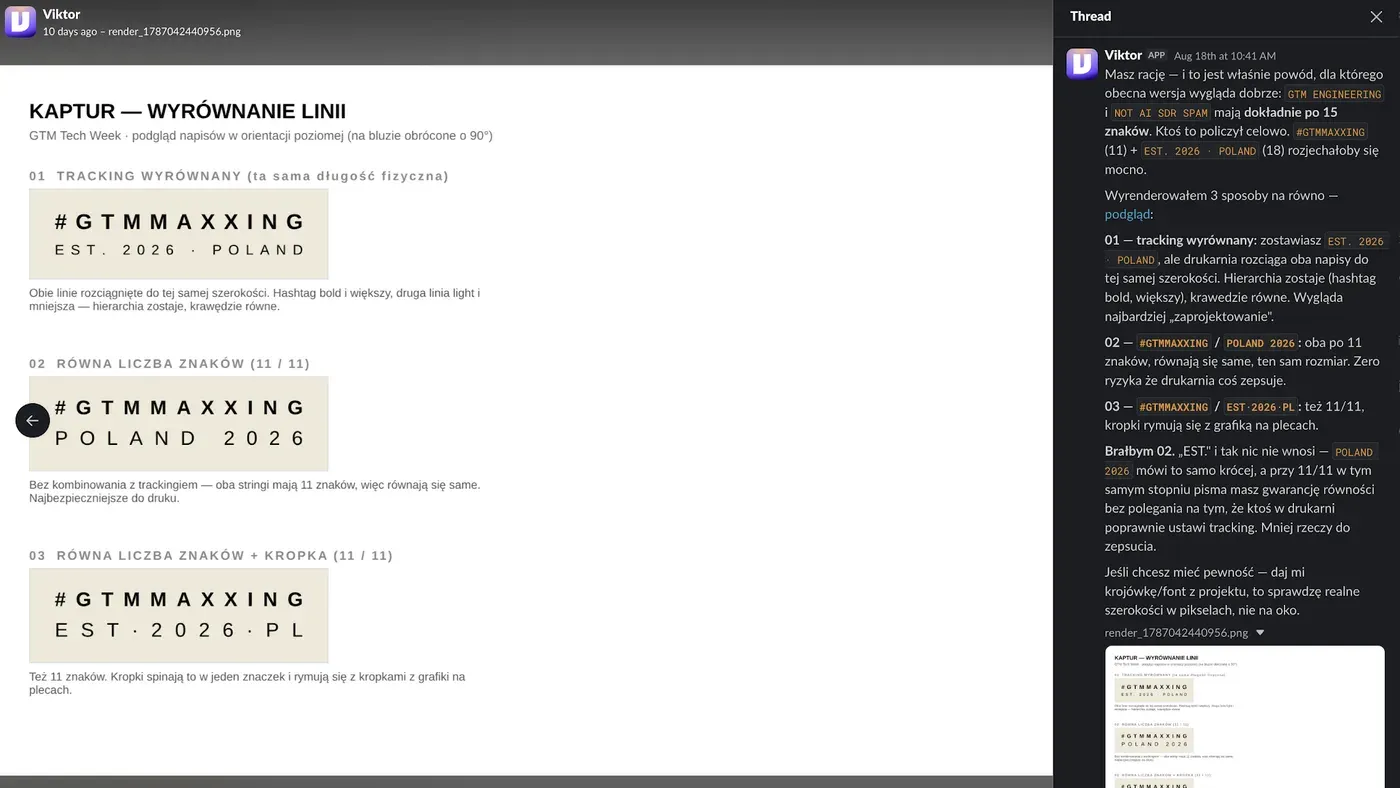
And the outcome? Look at this:
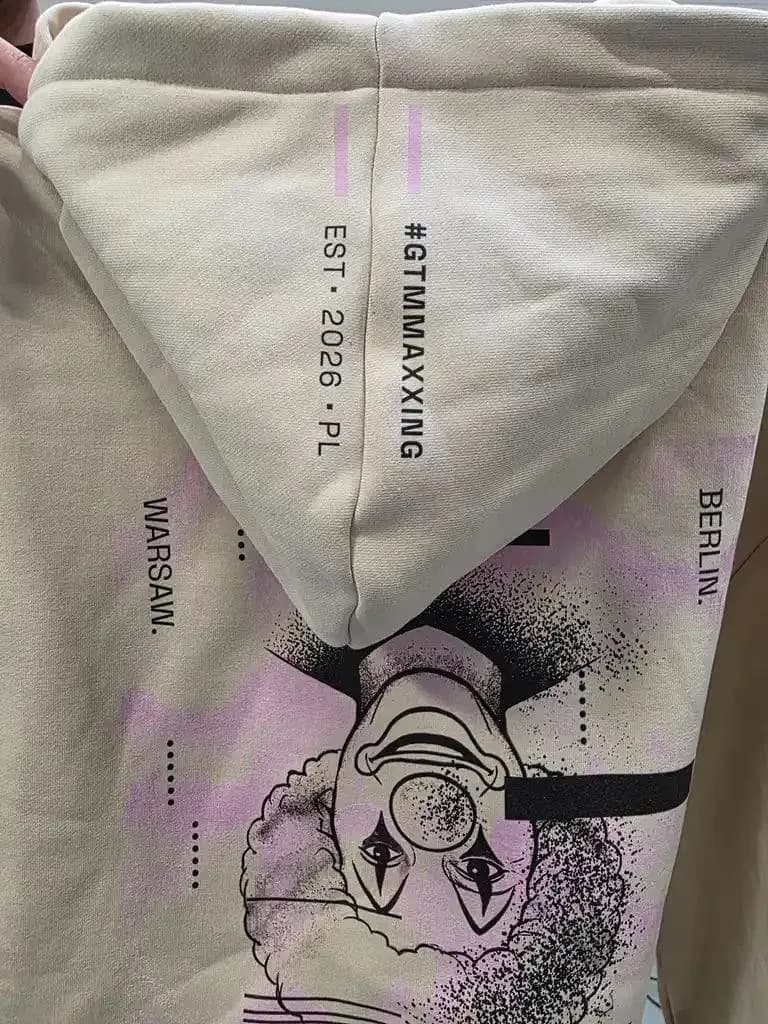
A fitting ending: even the Easter egg on the founding-member hoodie came out of the same loop. I gave Viktor an imperfect constraint, pushed back when the first answer would have looked wrong, and the second version went to production.
As I said: Viktor has taste.
GTM Tech Week is recruiting its first community cohort at gtm-week.com/community