
 Written with Viktor
Key Takeaways
- Agentforce is a platform for building AI agents inside the Salesforce ecosystem. You design each agent, write its instructions, configure its data sources, and deploy it through Salesforce's own infrastructure.
- Viktor is a single AI employee you hire into Slack or Microsoft Teams. No building step. You delegate work the way you would to a new team member, and he delivers finished output.
- The decision often comes down to team size and existing stack. If your company already runs on Salesforce with a dedicated admin team, Agentforce extends what you have. If you run a leaner operation and need output today, the employee model fits faster.
- Agentforce requires Salesforce as a foundation. Its agents reason over your CRM data using the Atlas Reasoning Engine, which means the quality of your Salesforce data directly determines how useful the agents become.
- Viktor works across 3,200+ tools regardless of your CRM. He connects to Salesforce, HubSpot, Stripe, Google Ads, Linear, Notion, and everything else through managed integrations with real read and write access.
- Where Agentforce genuinely wins: model flexibility and purpose-built agents for CRM-heavy workflows. Support deflection, sales coaching, and merchandising agents come pre-built and are tuned to Salesforce data models.
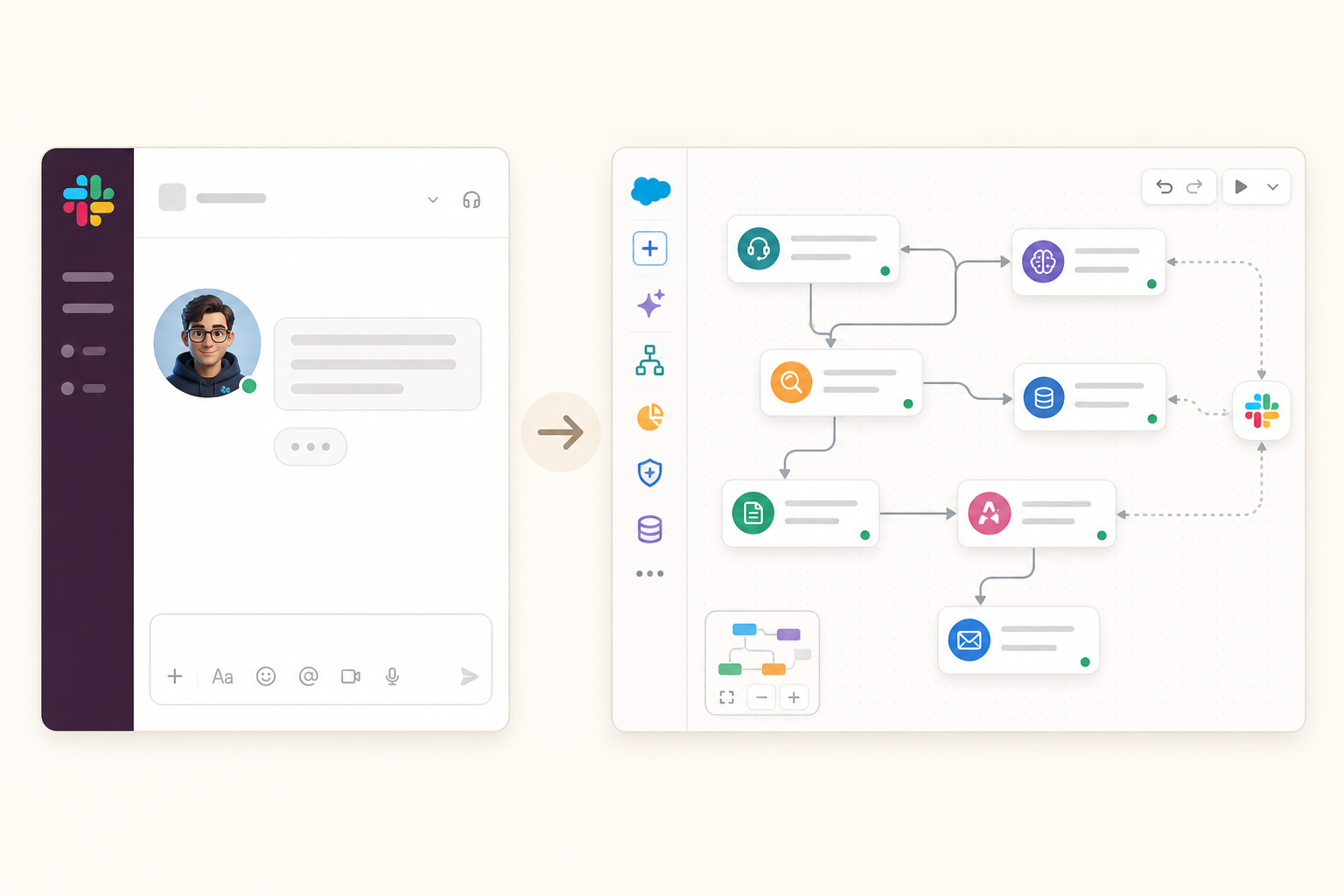
A tale of two assumptions
A head of revenue operations at a 40-person company opens two tabs. One is Salesforce's Agentforce page, which promises autonomous AI agents that handle service, sales, and marketing at enterprise scale. The other is Viktor's Slack install page, which promises an AI employee you can delegate to right now.
Both products use the phrase "AI agent." Both claim to automate real work. But they start from opposite assumptions about who does the setup, where the work happens, and what "ready" means.
This comparison is honest about both. Agentforce is a serious platform built by the company that defined CRM. For some teams, especially large ones running deep Salesforce implementations, it is the right choice. The goal here is to show the trade-off clearly so you pick the one that matches your team, not the one with the better landing page.
What is Salesforce Agentforce?
Agentforce is Salesforce's AI agent platform. It lets your team build, configure, and deploy autonomous agents that operate on your Salesforce data. The Atlas Reasoning Engine powers each agent, breaking down tasks into steps, evaluating options at each stage, and executing actions within the guardrails your team defines.
As of mid-2026, Agentforce ships several pre-built agent types: a Service Agent for customer support, a Sales Development Representative that engages prospects around the clock, a Sales Coach for rep training, a Merchandiser for ecommerce operations, a Campaign Optimizer for marketing, and a Buyer Agent for B2B purchasing. You can also build custom agents from scratch using Agent Builder, a unified workspace where you define logic in either a visual canvas or Agent Script, Salesforce's domain-specific scripting language.
The platform supports multiple AI models. The Atlas Reasoning Engine now runs on models from Anthropic, OpenAI, and Google Gemini via Amazon Bedrock, so your team can choose which model powers which agent. Data connectivity runs through Salesforce's own connectors, MuleSoft API integrations, and Data Cloud, which acts as the semantic layer grounding each agent in your company's records.
Agentforce Voice handles phone-based interactions with near-real-time conversational flow. Agents can update CRM records, trigger workflows, and escalate to human agents mid-call.
It is a full-featured platform, and the engineering behind the hybrid reasoning model (mixing deterministic logic with LLM judgment) is genuinely well-designed.
What is Viktor?
Viktor is an AI employee that lives in Slack and Microsoft Teams. You install him, connect the tools behind your recurring work, and start delegating in plain language. There is no builder, no scripting language, no data model to configure. The setup is closer to onboarding a new hire than deploying a platform.
He pulls the pipeline numbers from HubSpot and Stripe, drafts the client follow-up, assembles a board deck as a PDF, opens a pull request in GitHub, runs the weekly ad performance report from Google Ads and Meta, and ships an internal dashboard as a live app your team can open from a link. The range is wide because the integration layer is wide: 3,200+ tools with managed OAuth, real read and write access.
Sensitive actions wait for your approval in the same thread where you asked for them. He does not auto-send the customer email or auto-merge the PR. You review, approve, and he executes. Corrections and preferences accumulate as persistent memory shared across your team, so the tenth week is sharper than the first.
SOC 2 Type I certified, hosted on AWS, with review-first as the default safety model.
The quick comparison
| Capability | Viktor | Salesforce Agentforce |
|---|---|---|
| What it is | A managed AI employee for your team | A platform for building and deploying AI agent fleets |
| Where you interact | Slack and Microsoft Teams, natively | Salesforce UI, Agentforce Studio, Slack (via Agentforce in Slack) |
| Setup time | Install, connect tools, start delegating | Design agents in Agent Builder, configure data sources, test, deploy |
| Who configures it | Nobody; he learns from corrections | Your team: admins write Agent Script or use the visual canvas |
| Number of AI identities | One employee with growing skills | Multiple purpose-built agents per workflow |
| Models | Managed frontier model, auto-upgrades | Choose from Anthropic, OpenAI, Google Gemini via Bedrock |
| Integrations | 3,200+ with managed OAuth, read and write | Salesforce-native connectors, MuleSoft APIs, Data Cloud, MCP |
| Deliverables | PDFs, Excel, PowerPoint, live dashboards, code PRs | CRM actions, case resolutions, conversation summaries, Flows |
| Scheduled work | Built-in recurring tasks in chat | Scheduled and event-driven agent triggers |
| Safety model | Review-first approvals in your chat thread | Agent Script guardrails, escalation rules, enterprise governance |
| Data foundation | Connects to your tools via API; no prerequisite platform | Requires Salesforce CRM and Data Cloud for full capability |
Where Agentforce is strong
Being honest about a competitor's strengths is the only way a comparison earns trust.
Pre-built CRM agents that work on day one (within Salesforce)
If your team already runs Salesforce Service Cloud, the Service Agent replaces scripted chatbots with an AI that handles a wide range of support cases without pre-programmed decision trees. For sales teams on Sales Cloud, the SDR agent engages prospects, handles objections, and books meetings against live CRM data. These are not generic chatbot templates. They are tuned to Salesforce's data model and built by the team that knows it best.
Hybrid reasoning for predictable behavior
The Atlas Reasoning Engine's hybrid model, mixing deterministic Agent Script logic with LLM reasoning, solves a real problem. For compliance-heavy workflows where the agent must follow exact steps and only call the LLM for judgment calls, this architecture gives enterprise teams the control they need. You can read and audit the script that governs the agent's decisions, which matters when regulatory requirements are on the table.
Model choice
Some teams care deeply about which model runs their agents. Agentforce supports Anthropic, OpenAI, and Google Gemini, and lets you assign different models to different agents based on cost, capability, or policy constraints. Viktor manages the model for you, which is simpler but removes that option.
Voice agents
Agentforce Voice ships real-time, brand-aligned voice interactions out of the box. For contact center teams handling high call volume, this is a native capability that Viktor does not offer today.
Where the AI employee model wins
You can use it this afternoon
The deepest difference is time to first useful output. Agentforce's power comes from configuration, and configuration takes time. You need Agent Builder sessions, Agent Script definitions, Data Cloud setup, test cycles, and someone on your team who owns the agent fleet long-term. For a team with a Salesforce admin and a multi-month rollout budget, that investment pays off.
Viktor's first useful output usually happens the same afternoon you install him. A founder @mentions Viktor in a Slack thread asking for last week's revenue breakdown from Stripe, and it arrives in the reply. No agent was designed. No data source was wired. He just connected to Stripe and did the work.
@Viktor pull this week's closed-won deals from HubSpot, break them down by rep and deal size, and draft a summary I can paste into our Monday standup channel.That message works on the first day. With Agentforce, you would first build a sales reporting agent, define its data sources, test its output format, and deploy it. Both paths arrive at useful output, but the distance to the starting line is fundamentally different.
He works where your conversations already happen
Your team will not adopt a tool it has to remember to open. This is the adoption problem that sinks most enterprise AI deployments. Agentforce lives primarily inside Salesforce's own UI (though it offers a Slack integration). Viktor lives inside the channels where your team already discusses work. When the AI employee is a colleague in the thread rather than a destination you navigate to, usage compounds instead of decaying.
Teams that rolled out Viktor report the same pattern: one person delegates a task in a channel, others see the result, and within a week the whole team is using him without a training session or an internal wiki page about how to talk to the AI.
Finished work products, not just CRM actions
Agentforce excels at CRM-scoped actions: resolving cases, updating records, booking meetings, routing leads. Viktor's output extends further. He delivers polished PDFs, slide decks, Excel models, live dashboards with shareable URLs, code pull requests, formatted emails held for approval, and research briefs. The difference shows up when the job goes beyond the CRM.
A 20-person agency using Viktor asked him to pull Google Ads and Meta Ads performance, compare it to the client's Stripe revenue, write a monthly report as a branded PDF, and email it to the client. That is four tools, one deliverable, and one approval step in a Slack thread. Agentforce would need MuleSoft connectors to reach outside Salesforce, a custom agent to orchestrate the workflow, and a separate delivery mechanism for the PDF.
No platform dependency
Agentforce requires Salesforce as a foundation. That is not a criticism. It is a design decision, and for companies deeply invested in Salesforce, it is the right one because the agents reason over rich CRM data that already exists.
But many teams do not run Salesforce. They use HubSpot, or Pipedrive, or a spreadsheet, or some combination of tools they assembled as they grew. Viktor connects to all of them. His value does not depend on your CRM choice, your data warehouse, or your willingness to adopt a new platform.
How both products handle a real workflow
Consider a weekly pipeline review. The head of sales wants a summary of every deal that moved stages this week, the total pipeline value, and a list of deals that have been stuck for more than two weeks.
With Viktor
@Viktor pull every deal that changed stage in HubSpot this week. Show me total pipeline by stage, flag any deal stuck in the same stage for 14+ days, and format it as a PDF I can share with the exec team.Viktor connects to HubSpot, runs the query, formats the table, flags the stuck deals, builds the PDF, and holds it for your review in the Slack thread. If you correct the formatting or ask him to add a column, he remembers the preference for next week's run. You can set it as a recurring Monday task in one message.
With Agentforce
Your Salesforce admin builds a Pipeline Review Agent. They define the data scope (Opportunities from the current pipeline), write Agent Script logic to identify stalled deals (stage unchanged for 14+ days), configure the output format, test the agent in the simulation environment, and deploy it. When a rep or manager asks the agent for the review, it queries Salesforce Opportunities and returns results within the Salesforce interface. For teams that live in Salesforce all day, this workflow is smooth and deeply integrated.
The trade-off: Viktor's path is faster to set up and works across any CRM. Agentforce's path is more customizable and benefits from native Salesforce data richness. Neither is wrong. They are built for different teams.
Who should pick what
Agentforce fits your team if:
- You already run Salesforce as your CRM and have an admin or RevOps team that owns the configuration
- Your primary AI use cases are CRM-centric: support deflection, lead routing, sales coaching, case resolution
- You need enterprise governance features like Agent Script, hybrid reasoning controls, and model selection policies
- Your organization has the time and budget for a multi-week agent design and deployment cycle
- You want voice agents for a contact center operation
Viktor fits your team if:
- Your team is 10-50 people and you need AI output today, not after a platform rollout
- Your workflows span multiple tools beyond any single platform: CRM, ads, analytics, project management, communication
- You want one AI employee that learns and improves from corrections, not a fleet of agents to maintain
- You want deliverables beyond CRM actions: PDFs, dashboards, spreadsheets, code, branded reports
- You work in Slack or Microsoft Teams and want the AI to live there natively
Frequently Asked Questions
Can Agentforce work outside of Salesforce?
Agentforce connects to external systems through MuleSoft API connectors and supports MCP (Model Context Protocol) for broader tool access. But its reasoning engine, data grounding, and governance layer are built around Salesforce CRM and Data Cloud. External connectivity is possible, but Salesforce remains the center of gravity.
Does Viktor integrate with Salesforce?
Yes. Viktor connects to Salesforce through managed OAuth with read and write access. He can pull reports, update records, and trigger workflows. The difference is that Salesforce is one of 3,200+ integrations, not a prerequisite.
Can I use both?
Some teams do. Agentforce handles CRM-native agent workflows (support deflection, lead scoring) inside Salesforce, while Viktor handles cross-tool work in Slack: pulling ad data, drafting reports, building dashboards, managing tasks in Linear or Notion. They do not conflict because they occupy different surfaces.
How does each product handle security and compliance?
Agentforce inherits Salesforce's enterprise security posture: role-based access, audit trails, data residency controls, and SOC 2 compliance through the broader Salesforce platform. Viktor maintains SOC 2 Type I certification independently, runs on AWS, and uses a review-first model where sensitive actions require human approval before execution.
What if my team does not use Salesforce?
If your team does not use Salesforce CRM, Agentforce is not a practical option. The platform's reasoning and data grounding depend on Salesforce data. Viktor has no platform prerequisite. He works with whatever tools your team already uses.
Do I need a developer or admin to set up either product?
Agentforce requires someone who understands Salesforce administration, Agent Builder, and ideally Agent Script. Depending on complexity, that might be a Salesforce admin, a consultant, or an internal developer. Viktor requires no technical setup. You install the Slack or Teams app, connect your tools through guided OAuth flows, and start delegating.
How does each product improve over time?
Agentforce improves when your team refines agent logic, updates data sources, and adjusts Agent Script configurations. The agents are as good as the instructions and data your team provides. Viktor improves from corrections in conversation. When you tell him "next time, include the rep's name in the header," he remembers it across the team. Both approaches work, but one requires deliberate maintenance and the other learns from use.