
 Written with Viktor
Key Takeaways
- Onboarding rarely breaks at the signature. It breaks in the two weeks after. Access requests sit in someone's inbox, the kickoff deck gets rebuilt from scratch, and the client's first status update arrives late because nobody owned it.
- The work is mostly assembly, not judgment. Pulling the deal record, turning the intake form into a brief, opening the tracker, requesting ad account access, drafting the kickoff agenda: that is retrieval and formatting across five tools.
- An AI employee can own the assembly and hand you the judgment calls. It drafts, you approve. The client-facing parts never go out unreviewed.
- Write the onboarding sequence down once. A named steps file beats a person remembering. New account managers inherit the sequence instead of the folklore.
- Day 1 to day 30 needs a heartbeat, not a project plan. A recurring check that names what is still missing catches the stalled access request before the client does.
- Measure two things: days from signature to first deliverable, and how many onboarding steps got skipped. Both are countable, and both move within a month.
Why does client onboarding go wrong so often?
Because nobody owns the middle. Sales owns the deal until it closes. Delivery owns the account once work starts. The stretch between those two, where access, context and expectations get set, belongs to whoever has capacity that week.
Here is the version we see most: a paid media agency signs a new ecommerce client on a Thursday. The account manager sends a welcome email, asks for Meta and Google Ads access, and books a kickoff. The client's ops person forwards the access request to their agency of record, who is being replaced and takes nine days to respond. Nobody notices, because the request lived in one inbox. Kickoff happens with no data. The first optimization lands in week three, on a contract the client expected to see results from in week one.
Nothing in that story is a skill problem. It is a tracking problem, and tracking is exactly the kind of work you can hand to software that lives where your team already talks.
What can an AI employee actually do during onboarding?
It can do the assembly work end to end and stop at every point where a human should decide.
Concretely, for a new account it can:
- Read the closed-won record in your CRM and pull contract scope, contacts, start date and any notes the AE left
- Turn the intake form or discovery call notes into a one-page account brief in your own template
- Create the project in your tracker with the standard onboarding task list, dates counted from the start date
- Draft the welcome email and the access request, with the exact list of accounts and permission levels you need
- Draft a kickoff agenda from the brief, including the three questions the AE flagged as open
- Set up the recurring internal check that reports what is still missing
- Post a summary in the client's internal channel so delivery reads one message instead of five threads
What it should not do: decide whether scope creep is acceptable, negotiate the timeline, or send anything client-facing without your sign-off. Keep those with a person. Our post on keeping a human in the loop covers where to draw that line.
Which onboarding steps should you hand off first?
Start with the steps that are pure retrieval and formatting, then move up. This is the split we use:
| Onboarding step | Who should own it | Why |
|---|---|---|
| Pull contract scope and contacts from the CRM | AI employee | Data already exists in HubSpot or Attio, no judgment needed |
| Turn intake answers into an account brief | AI employee, human approves | Assembly work, but the brief sets delivery expectations |
| Create tracker project and dated task list | AI employee | Same template every time, dates derived from start date |
| Draft access request with exact permission levels | AI employee, human sends | Getting the permission list wrong costs a week |
| Chase the client for missing access | Human | Requires reading the room and sometimes a phone call |
| Kickoff agenda and pre-read | AI employee, human edits | Agenda is assembly, priorities are judgment |
| Agree on scope changes raised in kickoff | Human | Commercial decision, never delegate it |
| Weekly missing-items check for 30 days | AI employee | Recurring, boring, and the thing everyone forgets |
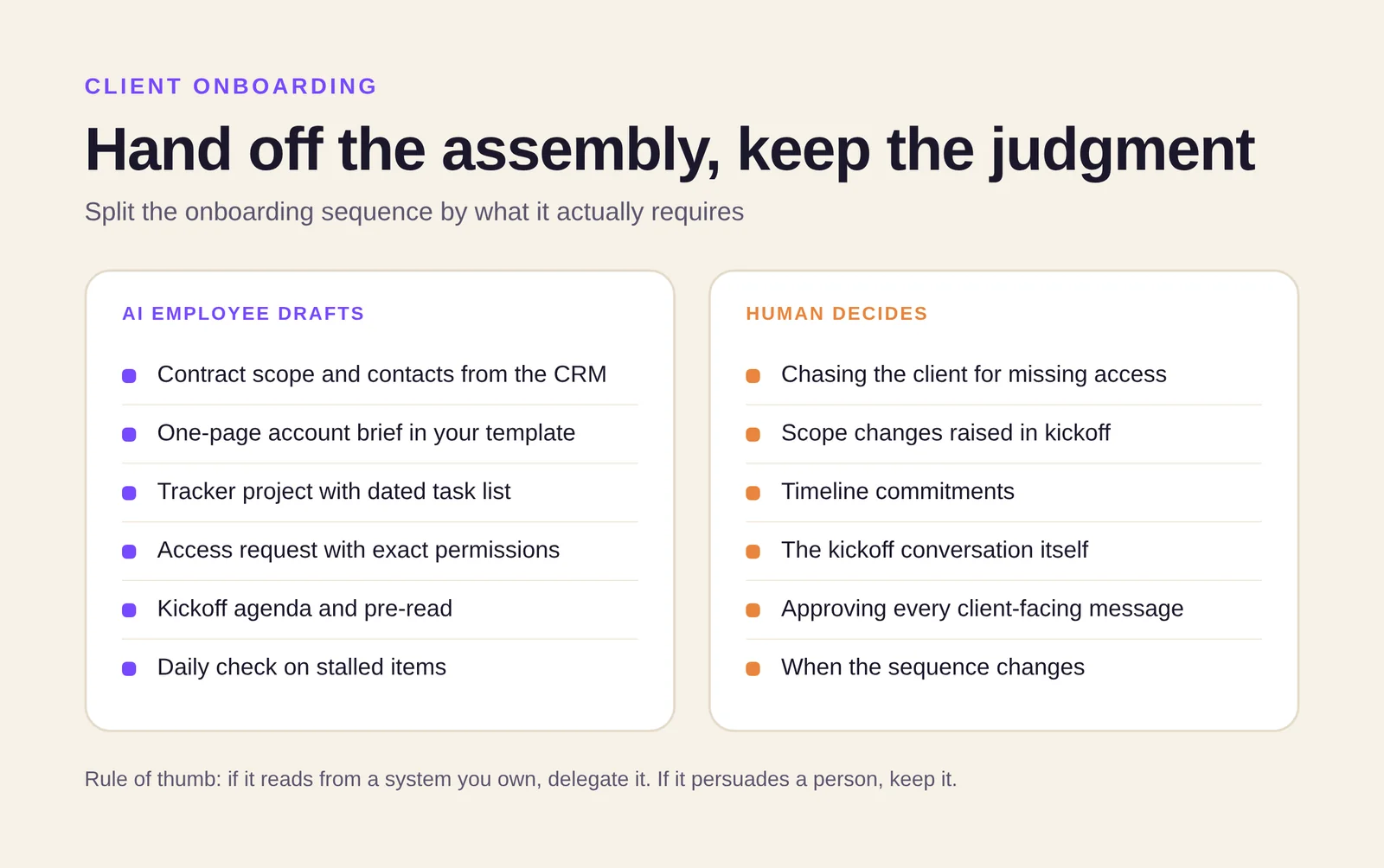
The pattern: anything that reads from a system you own is a good first handoff. Anything that requires a person to persuade another person stays human. Same rule we described in AI for agencies.
How do you set this up in a week?
Day 1: write the sequence down
Open a doc and list every step your best onboarding actually includes, in order, with who does it and when it happens relative to the start date. Most teams find between 14 and 22 steps, and find that half of them only live in one person's head.
This document becomes the instruction your AI employee follows. Ours reads it as a named skill, so the sequence survives people leaving. If you have never written one of these, how to write a brief your AI employee can run with is the format we use.
Day 2: connect the four tools onboarding touches
For most teams that is the CRM, the tracker, email and the shared drive. Skip the rest for now. Connecting twenty tools before you have one working sequence is the most common way this stalls.
Day 3: run it on the next signed client, in draft mode
Ask for the whole packet at once and read everything before it leaves the building:
New client signed: Northwind Coffee (closed-won in HubSpot yesterday). Read the deal record and the discovery notes in the attached doc, then give me: a one-page account brief in our template, the onboarding project in Linear with our standard 18 tasks dated from a 4 August start, a draft welcome email, and a draft access request listing the exact Meta and Google Ads permissions we need. Do not send anything, put it all in this thread for review.You will find two or three things wrong. That is the point of the first run. Fix the sequence file, not the individual output, so the correction sticks. We wrote about that habit in how to correct your AI employee.
Day 4 and 5: add the heartbeat
Onboarding fails quietly, so make silence loud. A recurring check that names missing items is the highest-value part of this whole setup:
Every weekday at 9am, for every account in onboarding status in Linear, check which tasks are overdue and which access requests have no reply after 48 hours. Post one message in #accounts with the account name, what is missing, and how many days it has been stuck. If nothing is stuck, say so in one line.Keep the one-line version for quiet days. If the check only speaks up on problems, people stop believing it is running. Setting up a recurring task walks through the mechanics.
What does the first 30 days look like once it runs?
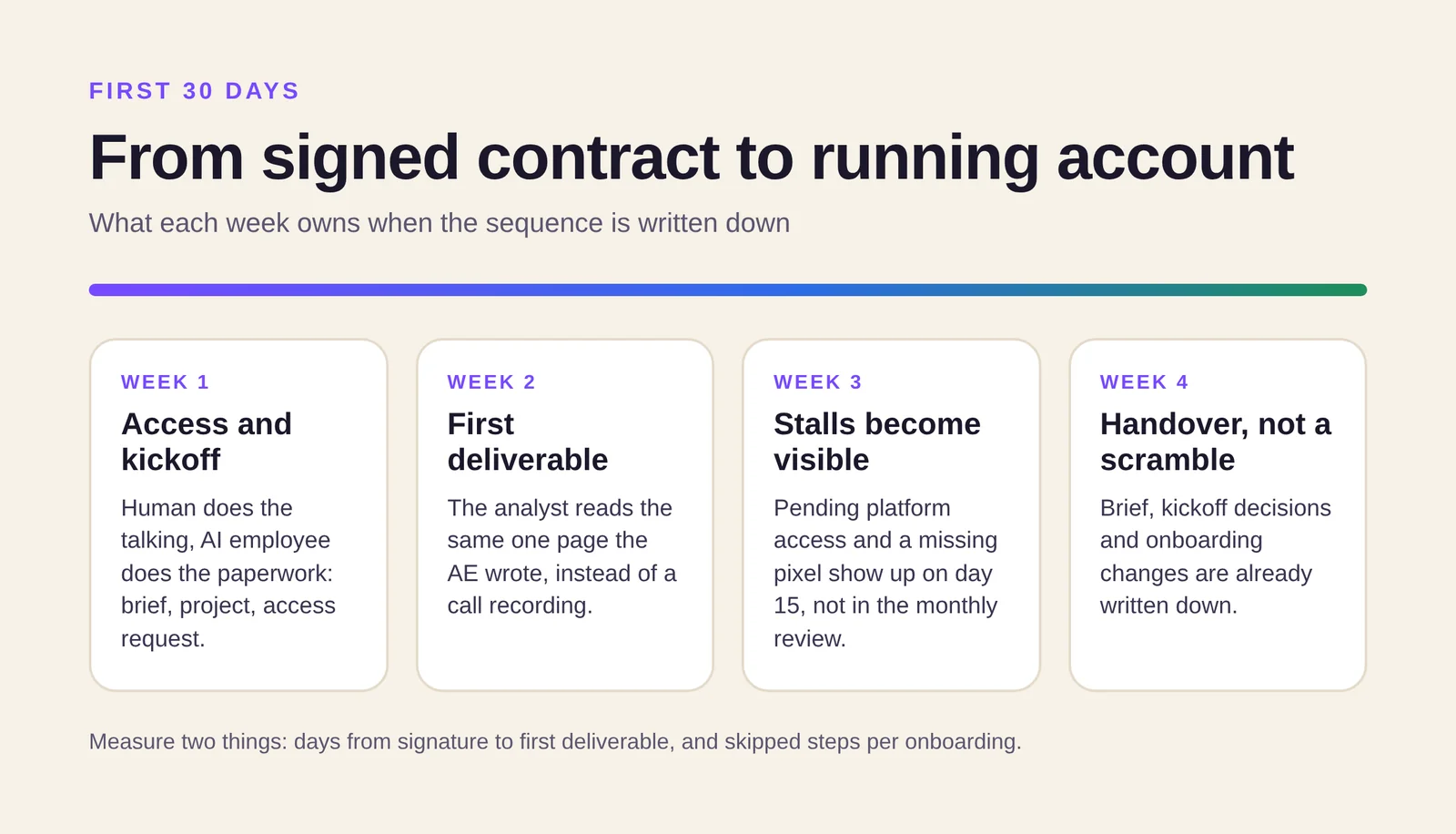
Week one is access, brief and kickoff, with the human doing the talking and the AI employee doing the paperwork. Week two is the first deliverable, where the value of the brief shows up: the analyst who builds the first report is reading the same one page the AE wrote the notes into, not reconstructing intent from a call recording.
Week three is where onboarding usually rots and where the daily check earns its keep. Access to one platform is still pending, a tracking pixel was never installed, and the client's second stakeholder has not been introduced. Those three items are visible on day 15 instead of surfacing in the first monthly review as complaints.
Week four is a handover, not a scramble. The account brief, the decisions log from kickoff and the list of what changed during onboarding are already written, because they were captured as the work happened rather than reconstructed for a report. Replacing weekly reporting covers the same principle applied to ongoing accounts.
How do you know it is working?
Two numbers, both easy to count and both honest:
- Days from signature to first deliverable. Pick your last five clients before the change and your next five after. If the median does not move, your bottleneck was never assembly work, it was capacity, and this will not fix it.
- Skipped steps per onboarding. Count the steps in your sequence file that were not completed within the window you set. Teams usually start somewhere around a third skipped and get that near zero, mostly because the daily check makes skipping visible.
Do not measure hours saved. Nobody logs onboarding hours accurately, and the number invites argument. Days and skipped steps are countable by anyone.
Where this breaks
Three honest failure modes.
If your onboarding is genuinely different every time, for example bespoke enterprise implementations with custom legal work per account, a sequence file will fight reality. Automate the parts that repeat, which is usually access and reporting setup, and leave the rest as human work.
If the data is not in a system, nothing can read it. Discovery notes that live in one person's notebook, or a scope agreed verbally on a call with no recording, cannot become a brief. The fix is upstream: make the AE write scope into the CRM before the deal closes.
And if you let drafts go out unreviewed to save a step, you will eventually send a client the wrong permission list or an agenda referencing another account. Review-first is what makes this safe to run on client-facing work at all, so keep it on.
Frequently Asked Questions
What is AI for client onboarding?
It is using an AI employee to run the assembly work between a signed contract and a running account: pulling deal data, building the account brief, creating the tracker project, drafting the welcome and access emails, and monitoring what is still missing during the first 30 days. Client-facing messages stay with a human to approve and send.
Can an AI employee send onboarding emails to clients on its own?
It can draft them and it should not send them unreviewed. Viktor is review-first by default: drafts wait for your approval before anything leaves the building. For onboarding, where a wrong permission list or a misnamed stakeholder is expensive, keep approval on every client-facing message.
Which tools does client onboarding automation need?
Four to start: your CRM, your project tracker, email and your shared drive. Viktor connects to 3,200+ integrations, so the list can grow, but a working sequence across four tools beats partial access to twenty. See which integrations your AI employee actually needs.
How long does it take to set up an onboarding sequence?
Writing the sequence down takes an afternoon if you already onboard clients consistently, and two afternoons if the steps live in different people's heads. Running it in draft mode on one real client is where the actual corrections happen, so plan for one full onboarding cycle before you trust it.
Does this work for agencies and for SaaS teams?
Yes, with different step lists. Agency onboarding is heavy on account access and reporting setup. SaaS onboarding is heavier on implementation milestones and admin configuration. The mechanic is the same: write the sequence, connect the systems it reads from, add a recurring check for stalled items.
What should never be delegated during onboarding?
Anything commercial or relational. Scope negotiation, timeline commitments, chasing a slow client, and the kickoff conversation itself. Those need a person who can read the room and make a call your company will stand behind.
Who owns the sequence once it is written?
One named person, usually whoever runs delivery. The AI employee follows the sequence and flags gaps, but a human decides when the sequence changes. Our post on who should manage your AI employee covers how teams split that ownership.